

Kṛṣṇa as Svayaṁ Bhagavān
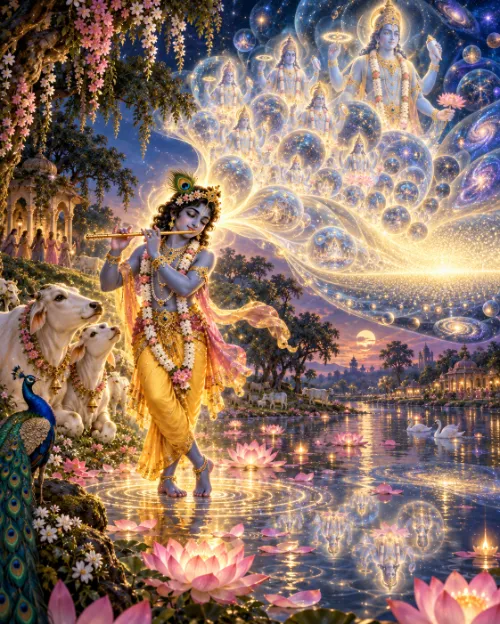
The Gauḍīya Theology of the Supreme Personal Reality
Who is Kṛṣṇa? Is He one avatāra among many? Is He a manifestation of Viṣṇu? Is Viṣṇu the original and Kṛṣṇa a later appearance? Or does the relationship run in the opposite direction?
Gauḍīya Vaiṣṇava theology gives an unusually precise answer. Kṛṣṇa is not presented merely as a powerful incarnation of God. He is identified as: Svayaṁ Bhagavān — Bhagavān Himself, the original personal source.
And this claim is compressed into a short Bengali couplet in the second chapter of the Caitanya-caritāmṛta:
স্বয়ং ভগবান্ কৃষ্ণ, বিষ্ণু–পরতত্ত্ব ।
পূর্ণজ্ঞান পূর্ণানন্দ পরম মহত্ত্ব ॥
svayaṁ bhagavān kṛṣṇa, viṣṇu-paratattva
pūrṇa-jñāna pūrṇānanda parama mahattva
“Kṛṣṇa is Svayaṁ Bhagavān, the supreme reality of Viṣṇu-tattva. He is complete in knowledge, complete in bliss, and supreme in greatness.”
Caitanya-caritāmṛta, Ādi 2.8
A. C. Bhaktivedanta Swami Prabhupāda translates: “Kṛṣṇa, the original form of the Personality of Godhead, is the summum bonum of the all-pervading Viṣṇu. He is all-perfect knowledge and all-perfect bliss. He is the Supreme Transcendence.”
The old English phrase “summum bonum of the all-pervading Viṣṇu” can sound obscure today. The theological meaning becomes clearer if we unpack the Bengali carefully: Kṛṣṇa is the ultimate source and fullest personal manifestation within Viṣṇu-tattva.
That one statement opens into the entire Gauḍīya understanding of: Brahman, Paramātmā, Bhagavān, Viṣṇu, Nārāyaṇa, Kṛṣṇa, and ultimately: Śrī Caitanya Mahāprabhu.
The First Claim: Svayaṁ Bhagavān
The verse begins:
স্বয়ং ভগবান্ কৃষ্ণ
svayaṁ bhagavān kṛṣṇa
The word:
स्वयम्
svayam
means: Himself, personally, in His own original identity. The phrase is deliberately rooted in one of the most famous theological declarations of the Śrīmad-Bhāgavatam.
एते चांशकलाः पुंसः
कृष्णस्तु भगवान् स्वयम् ।
इन्द्रारिव्याकुलं लोकं
मृडयन्ति युगे युगे ॥
ete cāṁśa-kalāḥ puṁsaḥ
kṛṣṇas tu bhagavān svayam
indrāri-vyākulaṁ lokaṁ
mṛḍayanti yuge yuge
“All these are portions or portions of portions of the Supreme Person, but Kṛṣṇa is Bhagavān Himself. They descend age after age to protect the worlds when they are disturbed by hostile forces.”
Śrīmad-Bhāgavatam 1.3.28
The critical words are:
कृष्णस्तु भगवान् स्वयम्
kṛṣṇas tu bhagavān svayam
“But Kṛṣṇa is Bhagavān Himself.”
This is stronger than saying: “Kṛṣṇa is divine.” It is stronger even than: “Kṛṣṇa is Bhagavān.” The distinctive claim lies in: svayam —Himself.
Why the Tiny Word Tu Matters
The Sanskrit particle:
तु
tu
means: but, however, on the other hand. The Bhāgavatam has just been enumerating avatāras. Then it says: kṛṣṇas tu… “Kṛṣṇa, however…” Gauḍīya theologians treat this contrast as doctrinally significant.
Jīva Gosvāmī gives kṛṣṇas tu bhagavān svayam a central interpretive role in his Kṛṣṇa-sandarbha. For him, this verse functions almost as a governing rule for reading the Bhāgavatam: numerous avatāras are manifestations of the Supreme, but Kṛṣṇa occupies the position of: Svayaṁ Bhagavān.
The difference is not between: God and: non-God. It is a distinction of: source and manifestation within divinity itself.
“Original” Does Not Mean Earlier in Time
This point must be handled carefully. If Kṛṣṇa is “the original,” does this mean there was once: Kṛṣṇa, but no Viṣṇu, and then Kṛṣṇa somehow produced Viṣṇu later? No. Gauḍīya theology does not understand the relation in material chronological terms.
The divine forms are eternal. “Original” means: ontological source not: earliest event in time. The Brahma-saṁhitā expresses this beautifully.
अद्वैतमच्युतमनादिमनन्तरूपम्
आद्यं पुराणपुरुषं नवयौवनं च ।
वेदेषु दुर्लभमदुर्लभमात्मभक्तौ
गोविन्दमादिपुरुषं तमहं भजामि ॥
advaitam acyutam anādim ananta-rūpam
ādyaṁ purāṇa-puruṣaṁ nava-yauvanaṁ ca
vedeṣu durlabham adurlabham ātma-bhaktau
govindam ādi-puruṣaṁ tam ahaṁ bhajāmi
“I worship Govinda, the primeval Lord, who is nondual, infallible, beginningless, and possessed of unlimited forms; He is the original and most ancient Person, yet eternally youthful. He is difficult to attain through the Vedas alone, but accessible to His pure devotees.”
Brahma-saṁhitā 5.33
Notice the apparent paradox: anādim without beginning, and: ādyam the original. There is no contradiction once “source” is understood ontologically rather than chronologically.
One Divine Reality, Unlimited Forms
The same verse calls Govinda:
अद्वैतम्
advaitam
nondual, and:
अनन्तरूपम्
ananta-rūpam
possessing unlimited forms. This is essential. Divine plurality does not imply multiple competing ultimate gods. The theological claim is: one undivided divine reality manifests eternally in innumerable personal forms.
Thus: Kṛṣṇa, Balarāma, Nārāyaṇa, Mahā-Viṣṇu, Garbhodakaśāyī Viṣṇu, Kṣīrodakaśāyī Viṣṇu are not understood as separate gods competing for supremacy. They belong to: Viṣṇu-tattva.
What Is Viṣṇu-tattva?
Now we can approach the central expression:
বিষ্ণু–পরতত্ত্ব
viṣṇu-paratattva
The word:
तत्त्व
tattva
means: truth, reality, ontological principle. Para-tattva means: the supreme reality, the ultimate principle. Thus: viṣṇu-paratattva means approximately: “the supreme or ultimate reality of Viṣṇu-tattva.”
This is probably clearer for modern readers than Prabhupāda’s phrase: “the summum bonum of the all-pervading Viṣṇu.” The intended theology is: within the complete divine category called Viṣṇu-tattva, Kṛṣṇa is understood as the original source-form.
Kṛṣṇa Is Not Competing With Viṣṇu
This distinction is crucial. Gauḍīya Vaiṣṇavism is not saying: Kṛṣṇa is God, but Viṣṇu is not. Nor does it say: Viṣṇu is a lesser “demigod.” Kṛṣṇa and Viṣṇu belong to the same fully divine category.
The distinction concerns: source, form, function, mood, and especially: rasa. A helpful—but limited—analogy is a candle lighting another candle. Every flame is fully luminous.
The second flame is not a defective imitation. Yet one may still speak of: source flame and: manifest flame. Divine expansion, however, differs from material division because the source is not diminished.
Kṛṣṇa does not become less complete by expanding Himself.
The Chapter Has Already Given the Bigger Formula
Ādi 2.8 should really be read together with Ādi 2.5.
यदद्वैतं ब्रह्मोपनिषदि तदप्यस्य तनुभा
य आत्मान्तर्यामी पुरुष इति सोऽस्यांशविभवः ।
षडैश्वर्यैः पूर्णो य इह भगवान् स स्वयमयं
न चैतन्यात् कृष्णाज्जगति परतत्त्वं परमिह ॥
yad advaitaṁ brahmopaniṣadi tad apy asya tanu-bhā
ya ātmāntar-yāmī puruṣa iti so ’syāṁśa-vibhavaḥ
ṣaḍ-aiśvaryaiḥ pūrṇo ya iha bhagavān sa svayam ayaṁ
na caitanyāt kṛṣṇāj jagati para-tattvaṁ param iha
“That nondual Brahman described in the Upaniṣads is the radiance of His body. The indwelling Puruṣa known as Paramātmā is His partial manifestation. He who is Bhagavān, complete in the six divine opulences, is this very Lord Himself. There exists no para-tattva higher than Kṛṣṇa Caitanya.”
Caitanya-caritāmṛta, Ādi 2.5
This verse gives the entire theological map.
Brahman, Paramātmā, and Bhagavān
The next Bengali verse states the structure explicitly:
ব্রহ্ম, আত্মা, ভগবান্—অনুবাদ তিন ।
অঙ্গপ্রভা, অংশ, স্বরূপ—তিন বিধেয়–চিহ্ন ॥
brahma, ātmā, bhagavān — anuvāda tina
aṅga-prabhā, aṁśa, svarūpa — tina vidheya-cihna
“Brahman, Paramātmā and Bhagavān are the three subjects; bodily effulgence, partial manifestation and original personal form are their respective characteristics.”
Caitanya-caritāmṛta, Ādi 2.6
The structure is:
The Bhāgavatam Gives the Foundation
वदन्ति तत्तत्त्वविदस्
तत्त्वं यज्ज्ञानमद्वयम् ।
ब्रह्मेति परमात्मेति
भगवानिति शब्द्यते ॥
vadanti tat tattva-vidas
tattvaṁ yaj jñānam advayam
brahmeti paramātmeti
bhagavān iti śabdyate
“Those who know the Absolute Truth describe that nondual reality as Brahman, Paramātmā, and Bhagavān.”
Śrīmad-Bhāgavatam 1.2.11
The decisive expression is:
ज्ञानमद्वयम्
jñānam advayam
“nondual reality/consciousness.”
So: Brahman, Paramātmā, Bhagavān are not rival Absolutes. The reality is: advaya nondual. Gauḍīya theology then claims that Bhagavān is the fullest personal realization of that same nondual truth.
Brahman as Kṛṣṇa’s Effulgence
Kṛṣṇadāsa Kavirāja continues:
তাঁহার অঙ্গের শুদ্ধ কিরণ–মণ্ডল ।
উপনিষৎ কহে তাঁরে ব্রহ্ম সুনির্মল ॥
tāṅhāra aṅgera śuddha kiraṇa-maṇḍala
upaniṣat kahe tāṅre brahma sunirmala
“The pure effulgence radiating from His form is what the Upaniṣads call the stainless Brahman.”
Ādi 2.12
This is a major Gauḍīya claim. Impersonal Brahman is not rejected. It is placed within a larger personal ontology.
Brahma-saṁhitā Says the Same
यस्य प्रभा प्रभवतो जगदण्डकोटि-
कोटीष्वशेषवसुधादिविभूतिभिन्नम् ।
तद्ब्रह्म निष्कलमनन्तमशेषभूतं
गोविन्दमादिपुरुषं तमहं भजामि ॥
yasya prabhā prabhavato jagad-aṇḍa-koṭi-
koṭīṣv aśeṣa-vasudhādi-vibhūti-bhinnam
tad brahma niṣkalam anantam aśeṣa-bhūtaṁ
govindam ādi-puruṣaṁ tam ahaṁ bhajāmi
“I worship Govinda, the primeval Lord, whose effulgence is the infinite, undivided Brahman extending through innumerable universes and their countless worlds.”
Brahma-saṁhitā 5.40
The logic is:
- Govinda
- His effulgence
- Brahman
Thus personal divinity does not emerge from impersonal Brahman. Within this Gauḍīya reading: Brahman emerges as the radiance of personal Bhagavān.
Bhagavad-gītā 14.27 Makes a Similar Claim
Kṛṣṇa says:
ब्रह्मणो हि प्रतिष्ठाहम्
अमृतस्याव्ययस्य च ।
शाश्वतस्य च धर्मस्य
सुखस्यैकान्तिकस्य च ॥
brahmaṇo hi pratiṣṭhāham
amṛtasyāvyayasya ca
śāśvatasya ca dharmasya
sukhasyaikāntikasya ca
“I am the foundation of Brahman—the immortal and imperishable reality, the basis of eternal dharma and ultimate happiness.”
The key phrase is:
ब्रह्मणः प्रतिष्ठा अहम्
brahmaṇaḥ pratiṣṭhā aham
“I am the foundation of Brahman.”
This became an important Vaiṣṇava proof-text for the priority of: personal Bhagavān over: impersonal Brahman.
Pūrṇa-jñāna : Complete Knowledge
Ādi 2.8 next says:
পূর্ণজ্ঞান
pūrṇa-jñāna
“complete knowledge.”
The word: pūrṇa means: full, complete, lacking nothing. Thus the claim is not simply: “Kṛṣṇa knows everything.” It is that knowledge belongs intrinsically to His divine nature.
He does not: learn, discover, reason His way toward truth, or overcome ignorance. His consciousness is: complete by nature.
The Upaniṣadic Background
The Taittirīya Upaniṣad famously describes Brahman:
सत्यं ज्ञानमनन्तं ब्रह्म ।
satyam jñānam anantaṁ brahma
“Brahman is reality, knowledge/consciousness, and infinity.”
Taittirīya Upaniṣad 2.1.1
The Upaniṣadic statement itself does not name Kṛṣṇa. The Gauḍīya theological move is to say that this unlimited conscious Absolute reaches its fullest personal manifestation in: Bhagavān Kṛṣṇa.
So pūrṇa-jñāna places Kṛṣṇa squarely within the classical Vedāntic conception of ultimate consciousness.
Pūrṇānanda : Complete Bliss
The next expression is:
পূর্ণানন্দ
pūrṇānanda
“complete bliss.”
Again: not merely “Kṛṣṇa feels happy.” Rather: bliss belongs to what He is. A famous Upaniṣadic passage says:
रसो वै सः ।
रसं ह्येवायं लब्ध्वानन्दी भवति ॥
raso vai saḥ
rasaṁ hy evāyaṁ labdhvānandī bhavati
“He indeed is rasa. Having attained that rasa, one becomes blissful.”
Taittirīya Upaniṣad 2.7.1
This becomes enormously important in Vaiṣṇava theology. Ultimate reality is not merely: being. It is not merely: awareness. It is also: ānanda and even: rasa relish.
Why Personality Is Not a Limitation
This is where Gauḍīya theology differs sharply from any philosophy that assumes personal attributes must make the Absolute smaller. One might reason: If God has: form, personality, relationships, love, then God must be limited.
Gauḍīya theology reverses the argument: if the Absolute lacked personality, relationship, love and bliss, then something real would be missing from the Absolute. Personal fullness is therefore not a defect.
It is: pūrṇatā completeness. And that is why pūrṇānanda ultimately opens into: Kṛṣṇa’s friendships, Yaśodā’s motherhood, the cowherd boys, Rādhā, the gopīs, and the entire theology of: rasa.
ईश्वरः परमः कृष्णः
सच्चिदानन्दविग्रहः ।
अनादिरादिर्गोविन्दः
सर्वकारणकारणम् ॥
īśvaraḥ paramaḥ kṛṣṇaḥ
sac-cid-ānanda-vigrahaḥ
anādir ādir govindaḥ
sarva-kāraṇa-kāraṇam
“Kṛṣṇa, known as Govinda, is the Supreme Lord. His form is eternal, conscious and blissful. He has no beginning, yet He is the origin of all and the cause of all causes.”
Brahma-saṁhitā 5.1 Gives the Perfect Parallel
This is almost a Sanskrit theological expansion of Ādi 2.8. Compare: pūrṇa-jñāna complete consciousness/knowledge, with: cit consciousness. And: pūrṇānanda complete bliss, with: ānanda bliss.
Sac-cid-ānanda-vigraha : Kṛṣṇa Does Not Merely Possess Bliss
The word:
विग्रह
vigraha
means: form. So: sac-cid-ānanda-vigraha means: “a form constituted of eternal existence, consciousness and bliss.” This is extremely important. Gauḍīya theology does not imagine: a spiritual Kṛṣṇa hidden inside a divine-looking body.
Kṛṣṇa’s form and Kṛṣṇa Himself are: non-different. His form is not material clothing around a spiritual self. His form itself is: sat-cit-ānanda.
This Is Completely Different From the Conditioned Jīva
The conditioned living entity has: a spiritual self covered by: gross and subtle material bodies. Kṛṣṇa is not understood in this way. His form is not produced by: karma, prakṛti, avidyā.
This distinction is fundamental. Otherwise someone might reason: “I have a body.” “Kṛṣṇa has a body.” “Therefore His body must be material like mine.” Gauḍīya Vedānta rejects that premise completely.
The similarity is: appearance. The ontology is: different.
Parama Mahattva : Supreme Greatness
The final expression is:
পরম মহত্ত্ব
parama mahattva
literally: “supreme greatness.” Prabhupāda renders this: “the Supreme Transcendence.” Theologically that works, but the Bengali is more directly: His greatness is supreme.
What kind of greatness? The preceding Sanskrit verse, Ādi 2.5, says:
षडैश्वर्यैः पूर्णः
ṣaḍ-aiśvaryaiḥ pūrṇaḥ
“complete in the six divine opulences.”
That points toward the classical definition of: Bhagavān.
The Six Opulences of Bhagavān
A famous Viṣṇu Purāṇa definition reads:
ऐश्वर्यस्य समग्रस्य
वीर्यस्य यशसः श्रियः ।
ज्ञानवैराग्ययोश्चैव
षण्णां भग इतीङ्गना ॥
aiśvaryasya samagrasya
vīryasya yaśasaḥ śriyaḥ
jñāna-vairāgyayoś caiva
ṣaṇṇāṁ bhaga itīṅganā
“Complete sovereignty, strength, fame, beauty or prosperity, knowledge, and renunciation—these six are known as bhaga, divine opulence.”
The six are traditionally understood as: aiśvarya — sovereignty, wealth; vīrya — strength; yaśas — fame; śrī — beauty, fortune; jñāna — knowledge; vairāgya — detachment. The one who possesses these in completeness is: Bhagavān.
Why Pūrṇa Matters So Much
Notice how often the idea of completeness appears. pūrṇa-jñāna complete knowledge. pūrṇānanda complete bliss. ṣaḍ-aiśvaryaiḥ pūrṇaḥ complete in all six opulences. The theological claim is therefore not merely: Kṛṣṇa has remarkable qualities.
It is: nothing necessary to ultimate divinity is absent in Him.
Yet Kṛṣṇa Appears as a Cowherd Boy
Now comes one of the great Gauḍīya paradoxes. If Kṛṣṇa possesses: parama mahattva supreme greatness, why does He spend His most celebrated līlās: herding cows, stealing butter, playing games, being scolded by Yaśodā, running barefoot through Vraja?
Because Gauḍīya theology distinguishes: aiśvarya majesty, from: mādhurya sweetness and intimacy. Kṛṣṇa’s majesty is not absent in Vraja. It is: hidden. And that hiddenness makes intimacy possible.
Complete Greatness Includes the Freedom to Hide Greatness
Ordinary power demands recognition. Kṛṣṇa’s greatness is depicted as so complete that He does not need His greatness constantly acknowledged. Yaśodā can think: “This boy needs me.”
The cowherd boys can think: “Kṛṣṇa is our equal.” Rādhā can quarrel with Him as Her beloved. The Supreme Lord permits love to conceal majesty. In Gauḍīya theology, that is not: less divinity.
It is: deeper sweetness.
Bhagavad-gītā 7.7 and Para-tattva
Kṛṣṇa tells Arjuna:
मत्तः परतरं नान्यत्
किञ्चिदस्ति धनञ्जय ।
मयि सर्वमिदं प्रोतं
सूत्रे मणिगणा इव ॥
mattaḥ parataraṁ nānyat
kiñcid asti dhanañjaya
mayi sarvam idaṁ protaṁ
sūtre maṇi-gaṇā iva
“There is no truth superior to Me, O Dhanañjaya. Everything rests upon Me like pearls strung upon a thread.”
The crucial statement:
मत्तः परतरं नान्यत्
mattaḥ parataraṁ nānyat
“There is nothing higher than Me.”
This corresponds directly to the idea of: para-tattva the supreme ontological principle. Ādi 2.8 is therefore making a very strong claim: there is no higher reality behind Kṛṣṇa.
Then Why Does the Chapter Speak of Caitanya?
This is perhaps the most important contextual point. Ādi-līlā Chapter Two is not merely trying to prove: Kṛṣṇa is Supreme. Its larger purpose is to establish: who Śrī Caitanya Mahāprabhu is.
Immediately after 2.8 comes:
‘নন্দসুত’ বলি’ যাঁরে ভাগবতে গাই ।
সেই কৃষ্ণ অবতীর্ণ চৈতন্যগোসাঞি ॥
‘nanda-suta’ bali’ yāṅre bhāgavate gāi
sei kṛṣṇa avatīrṇa caitanya-gosāñi
“He whom the Śrīmad-Bhāgavatam praises as the son of Nanda Mahārāja—that very Kṛṣṇa has descended as Caitanya Gosāñi.”
Caitanya-caritāmṛta, Ādi 2.9
So Kṛṣṇadāsa’s argument proceeds in two stages:
First:
Who is Kṛṣṇa? Svayaṁ Bhagavān.
Then:
Who is Caitanya? That same Kṛṣṇa. This is why Ādi 2.8 is central not only to Kṛṣṇa theology but also to: Caitanya theology.
The Architecture of Ādi Chapter Two
The chapter’s argument can be mapped remarkably clearly.
Brahman
is His: aṅga-prabhā effulgence.
Paramātmā
is His: aṁśa manifestation.
Bhagavān
is His:
That is the theological movement of the chapter.
“Fullest” Does Not Mean Viṣṇu Is Defective
Another crucial safeguard is necessary. If Kṛṣṇa is called the fullest manifestation, does that mean: Nārāyaṇa is deficient? No. Gauḍīya theology does not propose something crude like: Kṛṣṇa = 100% God, Nārāyaṇa = 90% God.
All Viṣṇu-tattva forms are: fully divine. The difference concerns what is: manifested. Kṛṣṇa manifests forms of intimacy and sweetness—especially in Vraja—that are not foregrounded in the majestic forms of Vaikuṇṭha.
Thus “fullness” refers especially to:
- the completeness of revealed qualities,
- relationships,
- and rasas,
- not to a shortage of divinity in other Viṣṇu forms.
Svayaṁ-rūpa : The Technical Gauḍīya Development
Later Gauḍīya theology systematizes this through categories such as:
स्वयंरूप
svayaṁ-rūpa
the original personal form;
तदेकात्मरूप
tad-ekātma-rūpa
forms one with Him while differing in appearance or function; and various empowered manifestations. Within this system: Vrajendra-nandana Kṛṣṇa —the son of Nanda in Vraja— occupies the position of: svayaṁ-rūpa.
This is a technical development of the phrase: svayaṁ bhagavān.
Why Vraja Matters
This makes the location of Kṛṣṇa’s “fullness” especially important. His supreme identity is not displayed most fully through: cosmic spectacle. It is displayed through: relationship.
In Vraja: Yaśodā binds Him. The cowherd boys defeat Him in play. The gopīs rebuke Him. Rādhā’s prema controls Him. The paradox is extraordinary: the Supreme reveals His highest greatness by allowing His greatness to disappear behind love.
That is one of the most distinctive ideas in Gauḍīya theology.
Pūrṇānanda Leads Naturally to Rasa
If Kṛṣṇa is: complete bliss then divine perfection cannot be static. Gauḍīya theology sees bliss as: relational. Kṛṣṇa experiences: friendship, parental affection, romantic love, service, humor, heroism, wonder.
This is why the theology of: pūrṇānanda eventually becomes the theology of: rasa. Kṛṣṇa is not simply: a conscious Absolute. He is: the relishable center of infinite spiritual relationships.
The Deep Connection With Śrī Caitanya
The logic goes further still. If Kṛṣṇa is: Svayaṁ Bhagavān, complete in knowledge, complete in bliss, and the supreme reality— why does He appear as Caitanya? The later chapters of Caitanya-caritāmṛta give an astonishing answer: because even complete divine bliss contains ever-deepening relational possibilities.
Kṛṣṇa desires to taste:
- Rādhā’s love for Him,
- His own sweetness as She experiences it,
- and the bliss She experiences by loving Him.
Thus pūrṇānanda is not static completion. It is: inexhaustible divine rasa. This is what eventually opens into the mystery of: Rādhā-bhāva-dyuti-suvalita Kṛṣṇa Caitanya.
A More Precise Modern Translation
For a modern publication, I would translate Ādi 2.8 as: “Kṛṣṇa is Svayaṁ Bhagavān, the supreme reality of Viṣṇu-tattva. His knowledge is complete, His bliss is complete, and His greatness is supreme.”
Or slightly more explanatory: “Kṛṣṇa is Bhagavān Himself, the original source within Viṣṇu-tattva—perfect in knowledge, perfect in bliss, and supreme in divine greatness.”
This captures the Bengali more transparently than the older phrase: “summum bonum of the all-pervading Viṣṇu.”
What the Verse Does Not Mean
Ādi 2.8 does not mean that:
- Kṛṣṇa and Viṣṇu are rival deities;
- Viṣṇu is only partly divine;
- Kṛṣṇa existed at an earlier moment in time and then created Viṣṇu;
- Brahman and Paramātmā are unreal;
- Kṛṣṇa’s humanlike form is material;
- divine expansion reduces the source;
- “complete bliss” means ordinary psychological happiness;
- or other Viṣṇu forms are defective because Kṛṣṇa is called fuller.
Those readings flatten a technical theological system into crude hierarchy.
What It Does Mean
The verse teaches that:
- Absolute Reality is nondual;
- Brahman, Paramātmā and Bhagavān represent different realizations or manifestations of that one Absolute;
- personal Bhagavān represents the fullest expression;
- Kṛṣṇa is identified as Svayaṁ Bhagavān;
- Viṣṇu and Nārāyaṇa are fully divine manifestations within Viṣṇu-tattva;
- Kṛṣṇa is understood as their source-form;
- this source relation is eternal rather than chronological;
- Kṛṣṇa’s form is sac-cid-ānanda, not material;
- His knowledge and bliss are complete;
- His divine greatness is supreme;
- and the chapter uses all of this to establish that Śrī Caitanya is that same Kṛṣṇa.
Caitanya-caritāmṛta Ādi 2.8 is deceptively short. But behind it stands an entire vision of reality. The Absolute is: one. Yet that one reality can be realized as: Brahman, Paramātmā, Bhagavān.
The Gauḍīya claim is that the personal Bhagavān includes rather than excludes the realities apprehended as Brahman and Paramātmā. Then comes the further claim: that Bhagavān is Kṛṣṇa.
Not merely an avatāra among avatāras. But: Svayaṁ Bhagavān. The Brahma-saṁhitā says:
ईश्वरः परमः कृष्णः
सच्चिदानन्दविग्रहः
īśvaraḥ paramaḥ kṛṣṇaḥ
sac-cid-ānanda-vigrahaḥ
“Kṛṣṇa is the Supreme Lord, whose form is eternal, conscious and blissful.”
And the Bhāgavatam says:
कृष्णस्तु भगवान् स्वयम्
kṛṣṇas tu bhagavān svayam
“Kṛṣṇa, however, is Bhagavān Himself.”
Kṛṣṇadāsa Kavirāja compresses both into:
স্বয়ং ভগবান্ কৃষ্ণ, বিষ্ণু–পরতত্ত্ব ।
পূর্ণজ্ঞান পূর্ণানন্দ পরম মহত্ত্ব ॥
svayaṁ bhagavān kṛṣṇa, viṣṇu-paratattva
pūrṇa-jñāna pūrṇānanda parama mahattva
“Kṛṣṇa is Svayaṁ Bhagavān, the supreme reality of Viṣṇu-tattva—complete in knowledge, complete in bliss, and supreme in greatness.”
And then the chapter reveals why all of this matters:
‘নন্দসুত’ বলি’ যাঁরে ভাগবতে গাই ।
সেই কৃষ্ণ অবতীর্ণ চৈতন্যগোসাঞি ॥
‘nanda-suta’ bali’ yāṅre bhāgavate gāi
sei kṛṣṇa avatīrṇa caitanya-gosāñi
“He whom the Bhāgavatam praises as the son of Nanda—that very Kṛṣṇa has descended as Caitanya Gosāñi.”
So the chapter’s final theological movement is breathtakingly simple:
- Brahman is His radiance.
- Paramātmā is His expansion.
- Bhagavān is His personal fullness.
- That Svayaṁ Bhagavān is Kṛṣṇa.
- And that Kṛṣṇa appears as Śrī Caitanya.
That is the real depth of Ādi 2.8.