

Why Kaṁsa Turned into a Gopī
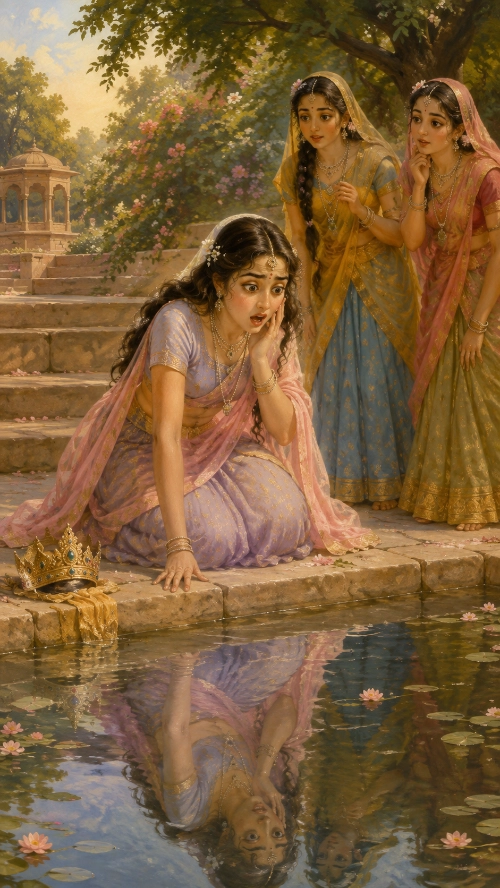
Why Did Kaṁsa Turn into a Gopī? The Mystery of Kiśorī-kuṇḍa
A Vraja story with a sting in it. Kaṁsa rides to Vṛndāvana meaning to carry off its most beautiful girls, stops at Kiśorī-kuṇḍa to drink, and stands up in the body of a gopī — the pond having drawn out, as ponds in Vraja will, the form hidden inside the desire. What follows is not a redemption. Rāsa Līlā d.d. tells it as a warning: Kaṁsa changed everything about himself except the one thing that mattered.
Hare Kṛṣṇa, dear devotees. Please accept my obeisances. Today we continue to hear and retell stories about Kṛṣṇa and Śrīmatī Rādhārāṇī. Today we will visit Yāvaṭa, the place where Śrīmatī Rādhārāṇī lived after Her marriage. First, let us recite the auspicious prayers.
oṁ ajñāna-timirāndhasya
jñānāñjana-śalākayā
cakṣur unmīlitaṁ yena
tasmai śrī-gurave namaḥ
“I was born in the darkest ignorance, and my spiritual master opened my eyes with the torch of knowledge. I offer my respectful obeisances unto him.”
nama oṁ viṣṇu-pādāya
kṛṣṇa-preṣṭhāya bhū-tale
śrīmate bhaktivedānta-
svāmin iti nāmine
“I offer my respectful obeisances unto His Divine Grace A. C. Bhaktivedanta Swami, who is very dear to Lord Kṛṣṇa, having taken shelter at His lotus feet.”
namas te sārasvate deve
gaura-vāṇī-pracāriṇe
nirviśeṣa-śūnyavādi-
pāścātya-deśa-tāriṇe
“Our respectful obeisances unto you, O servant of Sarasvatī Gosvāmī. You are kindly preaching the message of Lord Caitanyadeva and delivering the Western countries, which are filled with impersonalism and voidism.”
I heard this story from a Vaiṣṇava teacher, and it is also related in a book called Vraja-mahimā. The essential meaning of the story we are about to hear is this: in spiritual life we may change many things externally, but if we do not change our inner mood — our bhāva — then all those outward changes will ultimately lead nowhere.
Very often people try to deceive Kṛṣṇa, deceive themselves and deceive everyone else by changing external signs without seriously changing within, without attempting to transform their inner disposition. If, while practicing spiritual life, we continue clinging to our imagined independence — God forbid that anyone should take it away from us — then that is not genuine surrender.
Therefore, together with spiritual practice, we gradually learn to let go of our desire to control everything here: to control Kṛṣṇa, to control the devotees, even to control the spiritual master.
And today’s story concerns King Kaṁsa. We will hear how he came to Vṛndāvana, changed completely in external appearance — and yet inwardly remained exactly the same Kaṁsa.
Kaṁsa Comes to Vṛndāvana
King Kaṁsa lived in Mathurā. He had repeatedly heard that the most beautiful girls lived in Vṛndāvana. When villagers came to Mathurā bringing milk products and other goods — fresh butter, yogurt and so on — they would tell all kinds of stories about Vraja. Again and again Kaṁsa heard that there were extraordinarily beautiful girls there, and that the most beautiful of them all was Śrīmatī Rādhārāṇī.
At some point Kaṁsa thought: “I should go to Vṛndāvana myself. I have also heard that the boy I keep trying to kill lives there, and somehow I never succeed. Perhaps I should go there personally.”
He gathered a small army, mounted his chariot, and set out for Vṛndāvana. When he reached the area near Yāvaṭa, he thought: “This is said to be some kind of magical place. I had better leave my soldiers here and continue alone. Who knows what might happen?”
He also thought that if he saw some girls he liked, he could put them onto his chariot and take them away, with his small army there to support him. So he told his soldiers: “Stay here.” Then he continued alone in his chariot toward Yāvaṭa.
The Water of Kiśorī-kuṇḍa
Kaṁsa came to Kiśorī-kuṇḍa, which is described as a very unusual sacred pond. When we visited that place, we were warned: “Please be careful. If you drink the water of this kuṇḍa, very extraordinary things and transformations may occur.”
Kaṁsa approached the pond. It was a hot day, and he had traveled all the way from Mathurā, so he bent down and drank some of the water. Suddenly he heard his horses neighing anxiously. He thought: “What is happening?”
His horses were extremely well trained. They had excellent instincts, and they would neigh in that particular way only when they sensed a stranger nearby. Kaṁsa thought: “I am alone here. Is someone preparing to attack me?”
He began looking around. As a highly experienced warrior, he examined the entire area carefully. There was no danger. No one was nearby. Yet the horses continued neighing.
He bent toward the water again. And suddenly, reflected in the surface of the pond, he saw a woman’s face. Kaṁsa was bewildered. “Perhaps this is some kind of mermaid,” he thought. He could not believe his eyes. He leaned over the water again. The same face appeared. The horses continued neighing.
Then Kaṁsa began examining himself. And the longer he looked at his reflection, the more horrified he became. His body had transformed into the body of a young woman — a gopī. He touched himself in disbelief and realized that his entire form had changed. Something terrible, from his point of view, had happened to him.
Panic seized him. “How am I going to live now? How can I return to my army? First of all, no one will believe that I am Kaṁsa. And even if they do believe me, someone else will overthrow me. How can this be? All my life I have struggled to become emperor, ruler of the world. I imprisoned even my own father. And now I am going to end my days in this humiliating condition?”
Kaṁsa was completely terrified and confused.
Two Gopīs Meet the Mysterious Stranger
Then, on top of everything else, he heard the loud voices of young women. He saw two girls standing nearby, laughing and talking together. They approached Kiśorī-kuṇḍa and saw this unfamiliar young woman. They asked: “Oh, beautiful girl! Where have you come from? Who are you? What is your name? What village do you live in? Who are your parents? What service do you perform?”
These were ordinary questions among the residents of Vraja. Kaṁsa glared at them angrily. In his usual loud and commanding manner, he tried to declare: “I am Emperor Kaṁsa!”
The reaction of the gopīs was extraordinary. They pointed at him and laughed among themselves: “Did you hear that? She says she is the emperor! Just look at yourself!”
Kaṁsa became furious and started shouting: “I am Kaṁsa! I am Kaṁsa! I am the great Emperor Kaṁsa! I came here—” But to his horror, he heard his own voice. It was no longer the booming voice of a king. It sounded like the high voice of a young girl. He quickly bit his tongue, realizing that perhaps it would be wiser not to explain what he had actually intended to do there.
Then Lalitā, one of the girls, looked at him and said: “Ah, now everything is clear. Kiśorī-kuṇḍa fulfills desires. When someone drinks its water, the inner form or desire hidden within that person may manifest externally. And the fact that you, the terrible Kaṁsa, have turned into a cowherd girl must mean that some strong desire was hidden inside you. There can be no other explanation!”
At that moment, Lalitā heard her mistress’s voice inwardly. The gopīs are intimately connected with Śrīmatī Rādhārāṇī, and within her heart Lalitā heard Rādhā say: “Please bring this stranger to the palace.” So the girls took Kaṁsa by the hands and led him toward Śrīmatī Rādhārāṇī.
Kaṁsa Enters Rādhārāṇī’s Palace
They brought him into the palace associated with Mahārāja Vṛṣabhānu and Śrīmatī Rādhārāṇī. As Kaṁsa entered the reception hall, he looked around. He noticed the extraordinary refinement and beauty everywhere — the ornaments, carved furniture, painted walls, precious stones and decorations. He thought: “These cowherd people actually live very well!”
For just a moment he caught himself thinking: “Perhaps I should stay here. Life in Vṛndāvana is not bad at all.” But immediately he recovered himself. His Kaṁsa-bhāva — the mentality of emperor, master and controller — gave him no peace. His external form had changed. But inwardly he was still exactly the same Kaṁsa.
While speaking with Lalitā, he heard her say: “My mistress is extremely powerful. She can do anything. If you ask Her, She can fulfill your desire.” Kaṁsa asked: “What is the name of your mistress?” “Rādhā.” “How can I see Rādhā?”
They continued through the palace toward Śrīmatī Rādhārāṇī. When Kaṁsa entered a large and beautiful hall, he saw a throne upon which the exquisite Śrīmatī Rādhārāṇī was seated. He fell at Her feet. He looked at Her and beheld Her divine beauty. For a moment, something happened within his heart simply through contact with such spiritual beauty and mercy. But then he remembered: “I am Kaṁsa. I must do something to restore myself.”
He began pleading with Śrīmatī Rādhārāṇī: “Please restore my original form!” Śrīmatī Rādhārāṇī said: “Yes, yes. Of course. I understand what has happened to you.” Kaṁsa said: “Please! I will do anything — anything at all! Just give me back my form as Kaṁsa!”
Śrīmatī Rādhārāṇī looked at him with great compassion and said: “Great sages dream of becoming gopīs in Vṛndāvana. Ascetics perform tremendous austerities merely for the possibility of becoming cowherd girls in Vraja. And you have already become a gopī in Vṛndāvana. Perhaps you would like to remain here?”
In his shrill feminine voice Kaṁsa screamed: “I want to enjoy! I want to be king! I want to be emperor! I want power! I do not want to remain here! I cannot stand this! Inside I am a king and emperor. I must rule!” And he began crying. “I will do anything! Just return me to my former form!”
Śrīmatī Rādhārāṇī looked at him thoughtfully. “Anything? You will do absolutely anything?” “Yes! Anything!”
Then Śrīmatī Rādhārāṇī replied: “I know who you are, miserable Kaṁsa. You send various demons here into Vraja to trouble My beloved. So promise Me this: I will help you leave this place, but from now on you must never send anyone into Vraja again.”
Kaṁsa immediately began promising: “Yes, yes! Of course! I will never send anyone here again. And I myself will never come here again!”
Śrīmatī Rādhārāṇī told him: “Return to Kiśorī-kuṇḍa. Go out beneath the Sun. Bow before the Sun and make your solemn vow in its presence and before Lalitā. Then drink the water once more, and you will become Kaṁsa again.”
Kaṁsa Becomes Kaṁsa Again
Kaṁsa did exactly as She instructed. He ran back to Kiśorī-kuṇḍa. He drank the water. Without even looking back, he hurried to his horses, leapt onto his chariot and raced back to his army. When he reached them, he said: “That is enough. We are leaving this place. We are never coming here again!”
The Meaning of the Story
The essence of this story is that in spiritual life it is extremely important that our heart and inner mentality change. The controlling mentality must gradually be replaced by the mood of service, acceptance and surrender. The story is presented as a vivid illustration of how a person can change completely on the outside while remaining inwardly the same Kaṁsa.
External transformation alone is not spiritual transformation:
- we may wear different clothes;
- we may acquire different habits;
- we may take on the external signs of spiritual life.
But if the mentality within us remains — “I am the controller; I want things according to my will; I want to dominate” — then the fundamental transformation has not yet occurred.
Niṣṭhā: Steadiness Before Anything Else
Śrīla Rūpa Gosvāmī warns us about precisely this kind of danger. Śrīla Prabhupāda also explains that one should not try to proceed prematurely while the foundations of spiritual practice have not become steady. At the very least, we need to progress toward the stage of niṣṭhā — firm steadiness in devotional service.
Viśvanātha Cakravartī Ṭhākura defines niṣṭhā as stability, the constant application of effort in devotional service. Sometimes we make an effort. Sometimes we do not. Sometimes we think: “Everything is fine now. I can relax a little.”
But eventually a very strong and burning desire should awaken within us: “I want to love Kṛṣṇa.” And we should pray: “Kṛṣṇa, please give me bhakti.”
Then, when we chant the holy name or perform any service, we perform it with this single desire: “Please, Kṛṣṇa, give me bhakti.” If that desire becomes strong and sincere, and we continue chanting steadily, then the mantra becomes enlivened by that genuine longing. Our chanting then ceases to be merely a mechanical or karmic ritual from which we expect some future reward.
Therefore, let us chant sincerely with the desire to attain love for the Lord, and ultimately to attain our spiritual identity for the service of the Divine Couple, Śrīmatī Rādhārāṇī and Śrī Kṛṣṇa. Hare Kṛṣṇa.