

Śrī Lalitā-devī
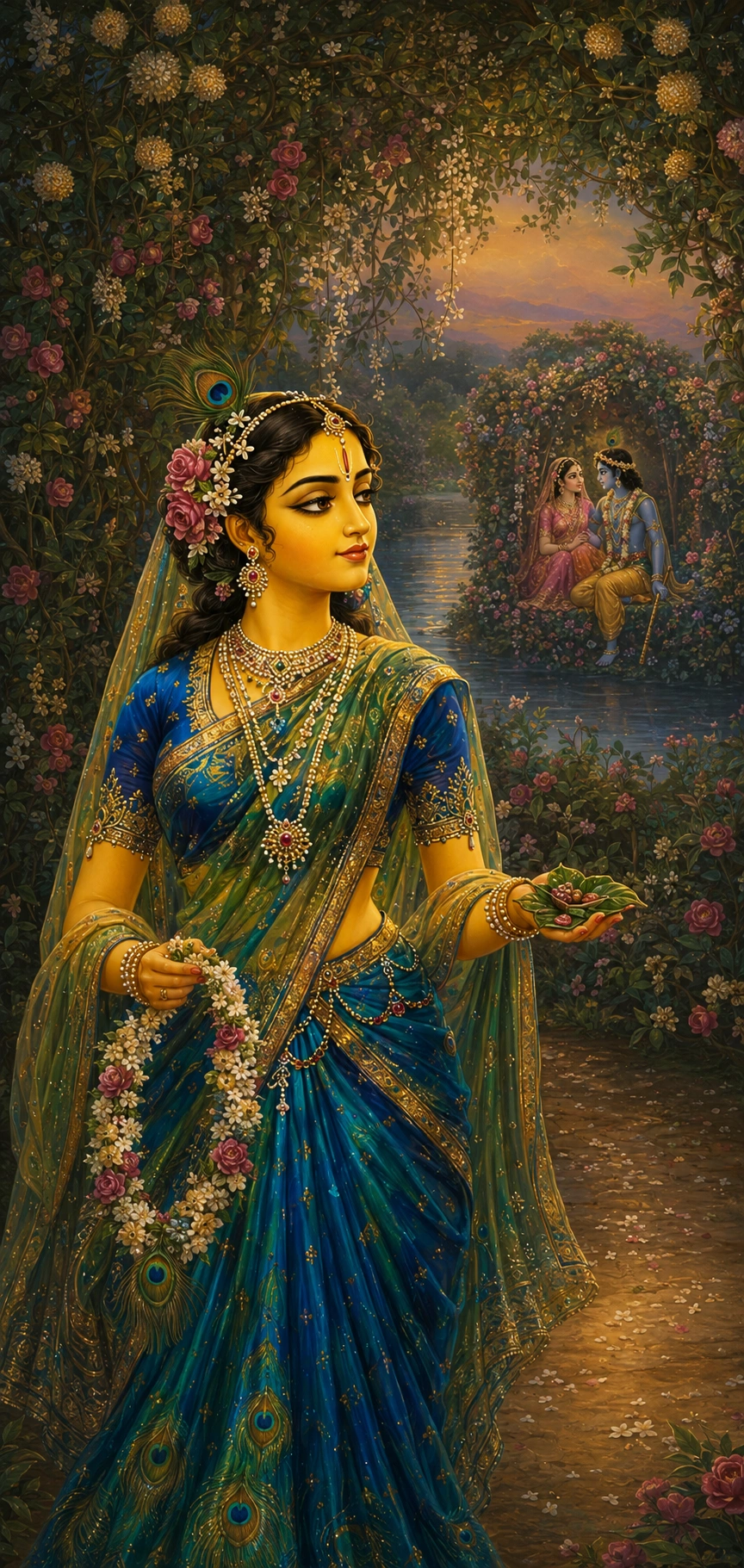
Śrī Lalitā-devī: The Fierce Intelligence of Rādhā’s Love
Among the intimate companions of Śrī Rādhā, Śrī Lalitā-devī occupies an exceptional position. She is one of the celebrated aṣṭa-sakhīs, the eight principal companions who surround Rādhā and Kṛṣṇa, but Gauḍīya texts do not present her merely as one member among eight. Rūpa Gosvāmī calls her the foremost of them, and later describes her as the chief supervisor of the most intimate sakhīs. She is brilliant yellow like gorocanā, dresses in colours compared to peacock plumage, is twenty-seven days older than Rādhā, and is famous for a personality at once graceful, fiercely intelligent and uncompromising.
Most characteristic of all is the expression vāma-prakharā (वामप्रखरा). Lalitā is “contrary” and “sharp” — but neither word should be understood in an ordinary psychological sense. Her sharpness is an expression of love. She is willing to argue with Kṛṣṇa, embarrass him, frustrate his plans, strengthen Rādhā’s loving indignation and prevent an easy reconciliation whenever she believes that doing so will protect Rādhā’s dignity and deepen the sweetness of their love. If Viśākhā often appears as a subtle diplomat, Lalitā is frequently the friend who tells Kṛṣṇa exactly what he does not want to hear.
And yet the same Lalitā is extraordinarily skilled in the tender arts of service: arranging secret meetings, preparing flower ornaments and beds, supervising tāmbūla service, decorating kuñjas and coordinating the many companions who assist the Divine Couple. The apparent contradiction is the key to understanding her. Lalitā’s severity toward Kṛṣṇa and her tenderness toward Rādhā are not two different sides of a personality. They arise from the same thing — total allegiance to Rādhā’s love.
Lalitā Among the Eight Principal Sakhīs
Rūpa Gosvāmī’s Rādhā-kṛṣṇa-gaṇoddeśa-dīpikā is one of the foundational Gauḍīya sources for the names, appearances, families, dispositions and services of the eternal associates of Rādhā and Kṛṣṇa. It names the eight variṣṭha-sakhīs:
- Lalitā
- Viśākhā
- Citrā
- Campakalatā
- Tuṅgavidyā
- Indulekhā
- Raṅgadevī
- Sudevī
And then singles Lalitā out immediately.
तत्राद्या ललितादेवी स्यादष्टासु वरीयसी ।
प्रियसख्या भवेज्ज्येष्ठा सप्तविंशतिवासरैः ॥
tatrādyā lalitā-devī syād aṣṭāsu varīyasī
priya-sakhyā bhavej jyeṣṭhā saptaviṃśati-vāsaraiḥ
“Of these eight, Lalitā-devī is foremost. She is twenty-seven days older than her dear friend.”
Rādhā-kṛṣṇa-gaṇoddeśa-dīpikā 80
The important word is varīyasī — “more excellent,” “pre-eminent,” “foremost.” Lalitā is not simply the first name in a list; her precedence is meaningful. When Rūpa later turns from the sakhīs’ appearance to their actual activities, he gives her an even stronger designation: paramādhyakṣatā (परमाध्यक्षता), the position of chief supervisor among the most intimate sakhīs. This is why later Gauḍīya literature so often portrays her as a leader, an organiser and a teacher within Rādhā’s circle.
Why the Name “Lalitā”?
The Sanskrit adjective lalita can mean charming, graceful, playful, elegant, lovely, artful. This is almost paradoxically appropriate. Lalitā’s famous sharpness does not make her coarse; she is simultaneously the embodiment of refinement and one of the strongest personalities in Vraja. Her forcefulness is itself aesthetically perfect. She knows when softness would weaken rasa and when opposition will intensify it. That is why her name and her temperament do not contradict each other: her opposition is itself lalita — graceful, artful and perfectly suited to the līlā.
“Anurādhā” Is Another Name of Lalitā
अनुराधातया ख्याता वामप्रखरतां गता ।
गोरोचनानिभाङ्गी सा शिखिपिच्छनिभाम्बरा ॥
anurādhātayā khyātā vāma-prakharatāṁ gatā
gorocanā-nibhāṅgī sā śikhi-piccha-nibhāmbarā
“She is renowned as Anurādhā and possesses the nature of a vāma-prakharā. Her limbs resemble gorocanā, and her garments resemble peacock feathers.”
Rādhā-kṛṣṇa-gaṇoddeśa-dīpikā 81
This establishes a correction to some handwritten and secondary lists: Anurādhā is not a different sakhī here. It is another name of Lalitā.
Kavi Karṇapūra later gives a characteristically Gauḍīya explanation of the name.
राधामनुगता यत्तल्ललिताप्यनुराधिका ।
rādhām anugatā yat tal lalitāpy anurādhikā
“Because Lalitā follows Rādhā, she is also Anurādhikā.”
Gaura-gaṇoddeśa-dīpikā 150
This should probably be understood as a devotional nirukti — a theological wordplay — rather than a strict historical derivation of the Sanskrit name. But it is extraordinarily expressive. Anu is “following, after”; so Lalitā is “she who follows Rādhā.” That captures her essential orientation. She does not lead in order to draw attention toward herself. She leads everyone toward Rādhā.
Complexion and Dress
So a richer description is this: Lalitā’s complexion shines like bright yellow gorocanā, while her garments possess the iridescent beauty of peacock feathers. The contrast is visually striking — luminous yellow against jewel-like peacock colours. The colour matters because the aṣṭa-sakhīs are individually characterised through distinctive complexions and garments. Their appearance is not generic, and Lalitā has her own recognisable visual identity.
Her Family
A small caution on the husband’s name. The Bhairava of this Vraja genealogy should not automatically be identified with Śiva in his Bhairava form simply because the same name occurs. In this context Bhairava is a cowherd personality within the Vraja social arrangement.
As often happens in Kṛṣṇa-līlā literature, ordinary family and marital structures form the outer social architecture within which the extraordinary confidential līlās of Rādhā and Kṛṣṇa unfold.
Twenty-Seven Days Older Than Rādhā
The traditional statement is exact: saptaviṃśati-vāsaraiḥ (सप्तविंशतिवासरैः), “by twenty-seven days.” Lalitā is twenty-seven days older than Śrī Rādhā.
This is worth emphasising because some English reproductions have transformed the statement into “Lalitā is twenty-seven years old.” That cannot be reconciled with Rūpa’s Sanskrit. The noun vāsara means day. The point is seniority by twenty-seven days, not an age of twenty-seven years.
Her Eternal Adolescent Age
Rūpa gives the relative difference between Lalitā and Rādhā but does not, in this passage, give Lalitā’s complete numerical age. That figure appears in the later meditative tradition of Dhyānacandra Gosvāmī.
चन्द्रताम्बूलसेवाढ्या दिव्याभरणमण्डिता ।
सप्तविंशत्यहोयुक्ताष्टमासमनुहायना ॥
candra-tāmbūla-sevāḍhyā divyābharaṇa-maṇḍitā
sapta-viṃśaty-aho-yuktāṣṭa-māsa-manu-hāyanā
“Rich in the service of candra-tāmbūla and adorned with divine ornaments, she is fourteen years, eight months and twenty-seven days old.”
Dhyānacandra Gosvāmī, Gauragovindārcanasmaraṇapaddhati 195
The text’s transmitted numerical gloss gives fourteen years, eight months and twenty-seven days. This belongs to the contemplative theology of the nitya-kiśorī form, the eternal adolescent identity of the Vraja associates, and should not be understood as an ordinary biological age that goes on increasing year after year. The point is an eternal līlā-age, part of the fixed aesthetic form in which the associate eternally participates in Kṛṣṇa’s youthful pastimes.
What Vāma-prakharā Actually Means
The short description “sharp and contrary” is essentially right but needs explanation, because without context it can sound insulting. In Sanskrit rasa theory it is not. The expression combines two classifications.
Lalitā therefore combines vāmatā, resistance, with prakharatā, forceful boldness — a strongly resistant, outspoken sakhī who vigorously protects Rādhā’s loving dignity. That is a good deal more precise than saying she “has a bad temper.”
Her Anger Is a Form of Service
This distinction is essential. Lalitā is not angry with Kṛṣṇa out of ego, insecurity or personal resentment. Her anger is entirely Rādhā-centred. If she believes Kṛṣṇa has neglected Rādhā, broken an agreement, arrived late, offered a suspicious excuse, given attention to another gopī or otherwise wounded Rādhā’s feelings, Lalitā may become formidable. She may:
- contradict Kṛṣṇa;
- expose his excuses;
- refuse his request;
- instruct Rādhā not to forgive him too easily;
- intensify Rādhā’s māna;
- embarrass him with clever words.
This is not a failure of devotion. It is one of the mysteries of Vraja-bhakti — that intimacy allows opposition to become love. In majesty-centred devotion, contradicting Bhagavān may seem almost unthinkable. In Vraja, however, aiśvarya is eclipsed by intimacy. Lalitā does not principally think, “Kṛṣṇa is the almighty Supreme Lord, therefore I must agree with him.” She thinks, “Kṛṣṇa has made Rādhā unhappy, therefore he must answer for himself.” That is the extraordinary freedom produced by prema.
Why She Sometimes Makes Reconciliation Harder
Rūpa’s description of Lalitā’s services is unusually subtle. She understands the emotional states of both Rādhā and Kṛṣṇa, and she can arrange either of two things.
She does not mechanically pursue reunion at every moment. Sometimes rasa requires meeting; sometimes it requires delay; sometimes Rādhā’s loving anger must be strengthened rather than immediately dissolved. Rūpa therefore describes Lalitā as capable of actively increasing Rādhā’s māna by supplying precisely the thoughts and arguments appropriate to the occasion — and then, at another moment, cooperating with Paurṇamāsī and others to arrange the reconciliation. This is why she is not simply a messenger. She is something closer to a director of emotional rasa, who understands the whole dramatic movement.
The Chief Supervisor of the Sakhīs
Rūpa gives Lalitā the position of paramādhyakṣā, chief supervisor, and the leadership includes both emotional and practical responsibility. The intimate sakhīs collectively perform such tasks as:
- dressing Rādhā;
- arranging ornaments;
- assisting her journey to secret meetings;
- deceiving guardians when necessary;
- taking Rādhā’s side in loving disputes;
- serving foods and refreshments;
- guarding confidential information;
- singing, dancing and playing musical instruments;
- carrying messages;
- recognising precisely what service is appropriate at each moment.
Lalitā stands at the head of this network, and her leadership is not ceremonial. It is active.
A Master of Flower Arts
One of the most charming portions of the Rādhā-kṛṣṇa-gaṇoddeśa-dīpikā describes Lalitā’s artistic abilities. She is expert in making, from flowers:
- crowns;
- hair ornaments;
- earrings;
- forehead decorations;
- necklaces;
- armlets;
- waist-belts;
- bracelets;
- ankle ornaments;
- bodices;
- parasols;
- beds;
- canopies;
- secluded flower pavilions.
Rūpa describes some of these designs in considerable detail, and the resulting picture matters. The Lalitā who can defeat Kṛṣṇa in an argument is also the Lalitā who delicately arranges petals into ornaments for Rādhā. The same intelligence functions in both; her sharp tongue and her artistic hands belong to one personality. The flower quarrel at Rādhā-kuṇḍa shows both at once.
Rūpa even says that Lalitā learned the art of producing certain elaborate flower crowns from Gāndharvā — Śrī Rādhā herself. This is a beautiful reversal: Lalitā is leader and teacher among the sakhīs, yet she herself learns from Rādhā. Her identity as Anurādhā, “she who follows Rādhā,” becomes meaningful again. Her authority is derivative in the most beautiful sense — she is powerful because she is completely aligned with Rādhā.
Tāmbūla-sevā
Lalitā is particularly associated with tāmbūla-sevā. Tāmbūla is prepared betel leaf, normally combined with selected aromatic ingredients and areca nut and offered as a fragrant refreshment; it appears frequently in descriptions of intimate royal and devotional service. Rūpa says Lalitā supervises the maidservants responsible for tāmbūla and even those who care for the betel vines, the areca-nut trees, the flower vines and the associated garden services.
Dhyānacandra later characterises her with the expression candra-tāmbūla-sevāḍhyā, “richly endowed with candra-tāmbūla service.” The word candra can also denote camphor in Sanskrit lexical usage, which explains the traditional interpretation that this refers to camphor-scented or camphor-prepared tāmbūla. It is therefore reasonable to summarise it this way: among Lalitā’s characteristic services is the preparation, offering and supervision of tāmbūla-sevā, with later meditative traditions especially associating her with camphor tāmbūla.
She Does Not Perform Everything Personally
This distinction is important. When a text says that a great sakhī is connected with a particular service, it does not always mean she personally performs every physical detail. Lalitā is repeatedly presented as a supervisor, directing groups of maidservants, younger sakhīs, garden attendants, tāmbūla servants and flower attendants. Her sevā therefore has an organisational dimension. She knows who should serve, what should be prepared, when it should appear, and how it should match the emotional state of the līlā. That makes her much closer to a master arranger than to one attendant among many.
Lalitānandada-kuñja
Later meditation literature associates Lalitā with a special grove. The fuller textual form preserved by Dhyānacandra is Lalitānandada-kuñja (ललितानन्ददकुञ्ज) rather than simply Lalitānanda-kuñja, and it may be understood approximately as “the grove that gives joy to Lalitā.” Dhyānacandra places it in the northern sector of his contemplative kuñja arrangement and describes Lalitā there with her gorocanā-like brilliance.
This is important when describing such locations. Texts of rāgānugā meditation sometimes organise Vraja through symbolic lotus-like arrangements, directional kuñjas and yogapīṭha visualisations. These should not always be flattened into a modern road map as though every directional statement belonged to one identical geographical diagram. Different devotional works may organise sacred space according to the requirements of contemplation.
Dhyānacandra also gives gṛham asyās tu yāvaṭe, “her home is at Yāvaṭa.” Yāvaṭa — also written Jāvaṭ in modern usage — is one of the important places connected with Rādhā’s married-household līlās. So Lalitā’s later meditative profile contains both her own kuñja in the sacred contemplative arrangement and her domestic residence at Yāvaṭa. These are not contradictory categories: one describes a site of intimate service, the other her place within the social geography of Vraja.
Lalitā’s Immediate Circle
Dhyānacandra preserves a traditional list of eight sakhīs associated particularly with Lalitā’s group. The transmitted readings include some variants:
- Ratnarekhā / Ratnaprabhā
- Ratikalā
- Subhadrā
- Candrarekhikā / Bhadrarekhikā
- Sumukhī
- Dhaniṣṭhā
- Kalahaṁsī
- Kalāpinī
Textual variation in names of this kind is not surprising. Gauḍīya works survive through manuscripts, printed editions, regional transmission and later compilations, and a single name may occasionally appear in more than one form. It is better to preserve genuine variants than to manufacture certainty where the textual tradition itself is not uniform.
The Theology of the Sakhīs
To understand why Lalitā can possess such extraordinary intimacy and authority, one must move beyond biographical details. The Caitanya-caritāmṛta gives the deeper explanation.
‘মহাভাব-চিন্তামণি’ রাধার স্বরূপ ।
ললিতাদি সখী — তাঁর কায়ব্যূহরূপ ॥
mahābhāva-cintāmaṇi rādhāra svarūpa
lalitādi sakhī — tāṅra kāya-vyūha-rūpa
“Rādhā’s nature is the cintāmaṇi of mahābhāva; Lalitā and the other sakhīs are forms of her kāya-vyūha.”
Caitanya-caritāmṛta, Madhya-līlā 8.165
Kāya-vyūha literally suggests an expansion or deployment of the body or form. In Gauḍīya theology, then, Lalitā and the intimate sakhīs are not merely unrelated souls who happen to become Rādhā’s friends. They are understood as personal expansions of her own devotional potency and love.
This should not be misunderstood to mean that Lalitā lacks individuality. She speaks, she decides, she argues, she serves, and she possesses her own appearance and temperament. The theology holds both realities together: real personal distinction, and profound ontological unity with Rādhā’s love.
The Sakhīs Make the Līlā Grow
সখী বিনা এই লীলা পুষ্ট নাহি হয় ।
সখী লীলা বিস্তারিয়া, সখী আস্বাদয় ॥
sakhī vinā ei līlā puṣṭa nāhi haya
sakhī līlā vistāriyā, sakhī āsvādaya
“Without the sakhīs this līlā does not become fully nourished. The sakhīs expand the līlā and themselves relish it.”
Caitanya-caritāmṛta, Madhya-līlā 8.203
Lalitā is perhaps the clearest embodiment of all three. She creates situations. She prevents premature resolutions. She arranges meetings. She intensifies separation. She protects Rādhā’s dignity. And she enjoys the resulting rasa.
A Friend Who Can Rebuke Kṛṣṇa
This leads to one of the most striking features of Gauḍīya theology: Lalitā may chastise Bhagavān, and this is not treated as impiety. Why not? Because the object of Gauḍīya Vraja-bhakti is not simply divine sovereignty. Kṛṣṇa’s majesty is real, but in Vraja it is overwhelmed by mādhurya, intimate sweetness. Yaśodā binds Kṛṣṇa. The cowherd boys climb onto his shoulders. The gopīs accuse him of dishonesty. And Lalitā can look at him as though he were a troublesome young man who must explain why he has offended her dearest friend. This intimacy does not deny his divinity; it shows the power of prema to conceal majesty.
Rādhā’s Protective Intelligence
There is a useful way to summarise her function. If Rādhā is the supreme embodiment of mahābhāva, Lalitā often appears as the protective intelligence of that love. She recognises danger to rasa. She recognises manipulation. She recognises when Kṛṣṇa’s charm is beginning to weaken Rādhā’s resolve. She intervenes, she encourages Rādhā, she challenges Kṛṣṇa, and she organises the other sakhīs.
Her famous harshness is therefore not random temperament. It has a theological purpose: Lalitā guards the value of Rādhā’s love. Kṛṣṇa cannot simply assume that Rādhā will always be immediately available. Lalitā makes him work for her mercy — and because he must work for it, the sweetness of obtaining it increases.
We can now return to Karṇapūra’s explanation, rādhām anugatā … anurādhikā. Lalitā follows Rādhā, and this does not imply passivity — quite the opposite. Her willingness to stand against Kṛṣṇa comes precisely because she stands with Rādhā. Her centre is not Kṛṣṇa considered independently; it is Rādhā-Kṛṣṇa in the form of Rādhā’s highest loving interest. That is why she can sometimes oppose their immediate union in order ultimately to deepen their love. Her deepest loyalty is not to the shortest route toward meeting. It is to the perfection of rasa.
Lalitā in Gaura-līlā: Why the Sources Look Confusing
A common Gauḍīya identification says: Lalitā-devī → Svarūpa Dāmodara Gosvāmī. This is not merely a modern tradition. Dhyānacandra Gosvāmī states it explicitly.
स्वरूपदामोदरतां प्राप्ता गौररसे त्वियम् ।
इयं तु वामप्रखरा गृहमस्यास्तु यावटे ॥
svarūpa-dāmodaratāṁ prāptā gaura-rase tv iyam
iyaṁ tu vāma-prakharā gṛham asyās tu yāvaṭe
“In Gaura-rasa she attained the identity of Svarūpa Dāmodara. She is vāma-prakharā, and her home is at Yāvaṭa.”
Gauragovindārcanasmaraṇapaddhati 197
So there is a clear textual foundation for Lalitā → Svarūpa Dāmodara, and Dhyānacandra’s same system associates Viśākhā with Rāmānanda Rāya. This mapping has become widespread in later devotional presentation. But it is not the only early Gauḍīya mapping.
Kavi Karṇapūra Gives a Different Identification
Kavi Karṇapūra’s Gaura-gaṇoddeśa-dīpikā presents a different arrangement. He identifies Gadādhara Paṇḍita with Śrī Rādhā, and then explains that Lalitā, as Anurādhikā, also entered that manifestation. His wording uses the verb prāviśat (प्राविशत्), “entered” — which already warns us not to treat these correspondences as a simple list of reincarnations. He even appeals to the dramatic theology of the Caitanya-candrodaya to express Gadādhara as embodying a complex union involving Rādhā, Lalitā and divine potency. So the flat statement “Lalitā became Gadādhara” is too crude. Karṇapūra’s language is closer to this: Lalitā’s identity or potency participates in the manifestation of Gadādhara together with Rādhā.
Karṇapūra then records another tradition — that some identify Dhruvānanda Brahmacārī as Lalitā. Instead of simply rejecting it, he says this view can also be considered proper, because of sva-prakāśa-vibheda (स्वप्रकाशविभेद), a differentiation of self-manifestation. This is extremely important: Karṇapūra himself is telling the reader that one Vraja personality can possess more than one corresponding manifestation in Gaura-līlā. These identity charts should therefore not be treated like ordinary genealogy. They are theological maps of manifestation.
Yet Karṇapūra Calls Svarūpa Dāmodara Viśākhā
कलामशिक्षयद्राधां या विशाखा व्रजे पुरा ।
साद्य स्वरूपगोस्वामी तत्तद्भावविलासवान् ॥
kalām aśikṣayad rādhāṁ yā viśākhā vraje purā
sādyā svarūpa-gosvāmī tat-tad-bhāva-vilāsavān
“She who in Vraja was Viśākhā and instructed Rādhā in the arts is now Svarūpa Gosvāmī, manifesting those respective moods and pastimes.”
Gaura-gaṇoddeśa-dīpikā 160
These cannot simply be collapsed into one identical list.
Is This a Contradiction?
At first sight, yes. But one should hesitate before imposing a rigid modern definition of identity on these texts. Karṇapūra himself provides the key, with expressions such as praveśa, entering; sva-prakāśa-vibheda, differentiated self-manifestation; and composite embodiment of several Vraja personalities. The underlying conception is not necessarily that person A dies and is reborn as person B. Several models appear instead.
Once these categories are recognised, the apparent contradiction becomes a good deal less crude. A source-critical entry should therefore not simply say “Lalitā was Svarūpa Dāmodara,” nor “that identification is wrong; Svarūpa was Viśākhā.”
A more accurate formulation preserves all the evidence. An important Gauḍīya meditative tradition represented by Dhyānacandra Gosvāmī explicitly identifies Lalitā with Svarūpa Dāmodara. Kavi Karṇapūra’s Gaura-gaṇoddeśa-dīpikā, however, identifies Svarūpa Dāmodara principally with Viśākhā, while connecting Lalitā with Gadādhara Paṇḍita through praveśa and also recording an identification with Dhruvānanda Brahmacārī through differentiated sva-prakāśa. Gauḍīya identity-correspondences need not always be one-to-one.
Why Svarūpa Dāmodara Still Feels Lalitā-like
Even where a text identifies Svarūpa with Viśākhā, it is easy to see why later devotional memory associates him so strongly with Lalitā. His function in Caitanya-līlā bears striking Lalitā-like characteristics:
- he is one of Mahāprabhu’s most intimate companions;
- he guards the purity of rasa and siddhānta;
- he exercises unusually strong judgement;
- he filters poetry before it reaches Mahāprabhu;
- he is not afraid to reject aesthetically pleasing work when its theology is wrong;
- he understands Caitanya’s deepest moods.
Personality resemblance alone does not prove an ontological identity. But it explains why the Lalitā–Svarūpa correspondence has such powerful devotional resonance. Lalitā guards Rādhā’s rasa in Vraja; Svarūpa guards Mahāprabhu’s rasa in Nīlācala. The functional parallel is remarkable.
Lalitā as “Guru of the Sakhīs”
Later Gauḍīya praise also celebrates Lalitā as a teacher among the sakhīs, and this should be understood correctly. She is not their guru in the conventional institutional sense of giving formal initiation. Rather, she instructs them in service, in rasa, in appropriate behaviour, in artistic skill, in how to protect Rādhā’s interests and in how to respond to Kṛṣṇa. Rūpa’s own descriptions of her leadership and paramādhyakṣatā provide the foundation for this later language, and her authority is therefore both practical and aesthetic.
There is another paradox here. Lalitā is strong enough to command others, yet the centre of her identity is self-effacement in Rādhā’s service. She does not seek an independent relationship with Kṛṣṇa at Rādhā’s expense; her happiness is bound to Rādhā’s happiness. This is fundamental to the theology of the sakhīs. Their service is not “I want Kṛṣṇa” but “I want Rādhā and Kṛṣṇa’s love to flourish” — and for Lalitā specifically, “I want Rādhā’s love to receive its full honour.” That makes her fierce. It also makes her extraordinarily tender.
The Essential Portrait
It is easy to remember Lalitā merely as “the hot-tempered sakhī.” That is true in the most superficial sense and false in the deepest one, because her temperament cannot be separated from her service. She is sharp because Rādhā’s love is priceless. She is suspicious because Kṛṣṇa is clever. She encourages māna because easy reconciliation does not always produce the deepest rasa. She arranges union because separation cannot remain forever. She decorates kuñjas because divine love requires a fitting environment. She supervises tāmbūla because the smallest intimate service matters. She teaches the sakhīs because Rādhā must be served perfectly. And she follows Rādhā so completely that her traditional name Anurādhā becomes almost a summary of her existence. Her beauty and her severity are one; her artistic delicacy and her uncompromising speech are one; her leadership and her selflessness are one; her opposition to Kṛṣṇa and her service to Kṛṣṇa are one. Lalitā is the fierce intelligence of Rādhā’s love — the friend who refuses to let that love become cheap, easy or misunderstood, and who in doing so helps create the very intensity through which Rādhā and Kṛṣṇa’s līlā reaches its highest sweetness.
Principal Textual Sources
A Note on Source Layers
Not every traditional detail about Lalitā comes from the same historical text, and it is useful to keep the layers visible.
Keeping these layers visible does not weaken the tradition. It lets us see how the Gauḍīya portrait of Lalitā became increasingly detailed while remaining centred on the essential figure already visible in Rūpa Gosvāmī: Rādhā’s foremost, brilliant, fearless and utterly devoted sakhī.
Sanskrit and Bengali texts consulted online: Gaudiya Vedanta Publications / PureBhakti for the digital edition of the Rādhā-kṛṣṇa-gaṇoddeśa-dīpikā; GRETIL for Dhyānacandra Gosvāmī’s Gauragovindārcanasmaraṇapaddhati; the IGNCA edition of Kavi Karṇapūra’s Gaura-gaṇoddeśa-dīpikā; the Bhaktivedanta VedaBase for the Caitanya-caritāmṛta; and digital editions of the Ujjvala-nīlamaṇi tradition for the technical classifications of vāma and prakharā.