

Śrī Indulekhā-devī
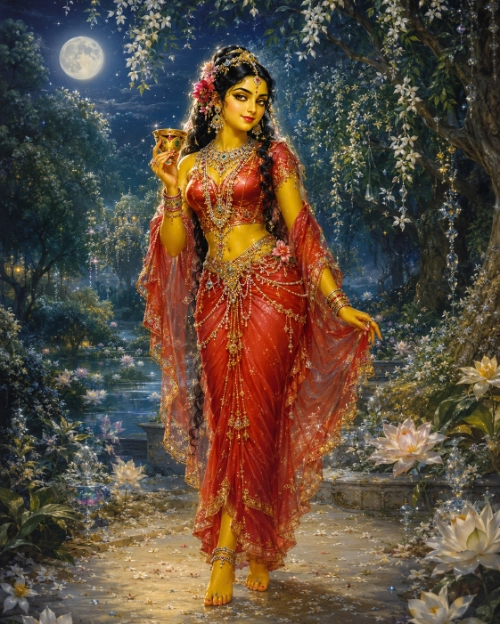
Śrī Indulekhā-devī: The Moon-Ray Sakhī of Śrī Rādhā
Śrī Indulekhā-devī is the sixth of the eight foremost companions of Śrīmatī Rādhārāṇī, the celebrated aṣṭa-sakhīs of Vraja. Popular summaries usually reduce her to a few memorable details: a brilliant yellow complexion, reddish garments, and an offering of honey to Kṛṣṇa. Those traditions are not meaningless, but the early Gauḍīya texts present a far richer personality.
Indulekhā is described as skilled in mantras, bodily signs, gems, ornament-making, painting, secret communication and the preparation of auspicious inscriptions. She supervises messengers and confidential servants. She is verbally forceful and difficult for Kṛṣṇa to overcome in argument. She protects Rādhā’s loving dignity, serves Kṛṣṇa personally, and presides over a remarkable moon-white grove designed for secrecy. Most importantly, Śrī Rūpa Gosvāmī gives the purpose behind her many skills in three words.
अन्योन्य-रागम् उत्पाद्य
anyonya-rāgam utpādya
“Causing their mutual attraction and love to arise.”
That short expression is the key to understanding Indulekhā. Her sharp speech, her secrecy, her artistic abilities, her management of messengers and even her resistance to Kṛṣṇa all serve one purpose: to deepen the love between Rādhā and Kṛṣṇa.
The Main Sources
Two further works help in interpreting these descriptions: the Caitanya-caritāmṛta, which explains the theology of the sakhīs’ service, and the Govinda-līlāmṛta, which gives a beautiful description of Indulekhā’s Pūrṇendu-kuñja.
A note about verse numbers. Numbering in printed editions of the Rādhā-kṛṣṇa-gaṇoddeśa-dīpikā is not uniform. Indulekhā’s introductory verses appear as 92–93 in one widely available printed edition and as 90–91 in others, and the passages on her skills and administrative responsibilities shift slightly as well. Verse numbers should therefore always be understood as edition-dependent. The Sanskrit wording matters more than pretending that one universal numbering system exists.
Indulekhā Among the Eight Principal Sakhīs
परम-प्रेष्ठ-सख्यस् तु ललिता स-विशाखिका ।
स-चित्रा चम्पकलता तुङ्गविद्येन्दुलेखिका ।
रङ्गदेवी सुदेवी चेत्य् अष्टौ सर्व-गणाग्रिमाः ॥
parama-preṣṭha-sakhyas tu lalitā sa-viśākhikā
sa-citrā campakalatā tuṅgavidyendulekhikā
raṅgadevī sudevī cety aṣṭau sarva-gaṇāgrimāḥ
“The supremely dear friends are Lalitā, Viśākhā, Citrā, Campakalatā, Tuṅgavidyā, Indulekhā, Raṅgadevī and Sudevī. These eight are foremost among all the groups.”
Ujjvala-nīlamaṇi 8.54
The Rādhā-kṛṣṇa-gaṇoddeśa-dīpikā gives essentially the same order.
ललिता च विशाखा च चित्रा चम्पक-वल्लिका ।
तुङ्गविद्येन्दुलेखा च रङ्गदेवी सुदेविका ॥
lalitā ca viśākhā ca citrā campaka-vallikā
tuṅgavidyendulekhā ca raṅgadevī sudevikā
Indulekhā is therefore consistently counted as the sixth of the eight. Some later Bengali traditions place Citrā and Campakalatā in the opposite order, but her sixth position remains unchanged.
Her Appearance
इन्दुलेखा भवेत् षष्ठी हरितालोज्ज्वल-द्युतिः ।
दाडिम्ब-पुष्प-वसना कनिष्ठा वासरैस् त्रिभिः ॥
indulekhā bhavet ṣaṣṭhī haritālojjvala-dyutiḥ
dāḍimba-puṣpa-vasanā kaniṣṭhā vāsarais tribhiḥ
“Indulekhā is the sixth. Her radiance is brilliant like haritāla. Her garment is the colour of the pomegranate blossom, and she is younger by three days.”
Rādhā-kṛṣṇa-gaṇoddeśa-dīpikā 92 in one commonly available edition; 90 in others
बेला-सागर-संज्ञाभ्यां पितृभ्यां जनिम् ईयुषी ।
वाम-प्रखरतां याता पतिर् अस्यास् तु दुर्वलः ॥
belā-sāgara-saṃjñābhyāṃ pitṛbhyāṃ janim īyuṣī
vāma-prakharatāṃ yātā patir asyās tu durvalaḥ
“She was born to parents named Belā and Sāgara. She possesses the nature of a vāma-prakharā. Her husband is Durvala.”
What Colour Is Haritāla?
The Sanskrit word haritāla refers to orpiment, the brilliant yellow mineral pigment traditionally used in South Asia. It is therefore misleading to describe Indulekhā as “tan.” “Greenish-yellow” is sometimes found in later descriptions, but the mineral comparison itself points more securely toward an intense golden-yellow or lemon-gold. And Rūpa does not merely say haritāla; he says haritāla-ujjvala-dyutiḥ — her radiance is ujjvala, luminous, bright, brilliant. Dhyānacandra repeats the comparison twice, as haritāla-samāṅgikā, “her limbs resemble haritāla,” and haritāla-samāna-deha-kāntim, “whose bodily radiance equals haritāla.”
The safest description is therefore that Indulekhā has a brilliant, saturated golden-yellow complexion, like the mineral pigment orpiment.
Her Pomegranate-Red Garments
Her clothing is described as dāḍimba-puṣpa-vasanā (दाडिम्ब-पुष्प-वसना), “clothed in the colour of pomegranate flowers.” Pomegranate blossoms are vivid scarlet to vermilion-red, and the visual effect is therefore striking — a brilliant golden-yellow complexion against intense pomegranate-red clothing. Dhyānacandra repeats the image as dāḍimba-kusumodbhāsi-vasanā, “her garments shine like pomegranate blossoms,” and later as vikasad-dārima-puṣpa-śobhi-vastrām, “her garment is beautiful like an opened pomegranate flower.” Her appearance is characterised by strong, luminous colour rather than muted tones.
Her Family and Home
अस्या माता भवेद् वेला पतिर् अस्यास् तु दुर्बलः ।
asyā mātā bhaved velā patir asyās tu durbalaḥ
“Her mother is Velā, and her husband is Durbala.”
गृहम् अस्यास् तु यावटे पिता सागर-संज्ञकः ॥
gṛham asyās tu yāvaṭe pitā sāgara-saṃjñakaḥ
“Her house is at Yāvaṭ, and her father is named Sāgara.”
The differences Belā/Velā and Durvala/Durbala should not automatically be treated as mistakes. The alternation between b and v is common in Bengali-transmitted Sanskrit traditions.
Yāvaṭ is the village associated with Rādhā’s married household, and in Gauḍīya līlā literature it is an especially sensitive environment, because her meetings with Kṛṣṇa must often remain hidden from elders and relatives. Indulekhā’s residence there fits remarkably well with the role later assigned to her as a guardian of confidential information. Lalitā is also placed at Yāvaṭ in Dhyānacandra’s system, so two particularly forceful and capable sakhīs are imagined as positioned very close to the place where secrecy is most necessary. This reading should not be mistaken for an explicit statement in the Sanskrit, but it fits the broader picture the texts create.
Her Age
Rūpa Gosvāmī says simply that Indulekhā is kaniṣṭhā vāsarais tribhiḥ, “younger by three days” — the comparison being with Śrī Rādhā. Dhyānacandra later gives a much more precise meditative age.
सार्ध-दिग्-वासरैर् युक्ता द्वि-मास-मनु-हायना ।
असौ तु वाम-प्रखरा हरेश् चामर-सेविनी ॥
sārdha-dig-vāsarair yuktā dvi-māsa-manu-hāyanā
asau tu vāma-prakharā hareś cāmara-sevinī
“She is fourteen years, two months, and ten and a half days old. She is vāma-prakharā and serves Hari with the cāmara.”
Gauragovindārcana-smaraṇa-paddhati 240
The numbers are given through the traditional poetic technique called bhūta-saṅkhyā, in which words stand for numbers.
Hence fourteen years, two months and ten and a half days. This should not be read like modern biographical chronology. Within this form of līlā-smaraṇa, precise details — age, colour, dress, grove, direction and service — help the practitioner hold a definite meditative form in the mind. We therefore have two levels of description: for Rūpa Gosvāmī, Indulekhā is three days younger than Rādhā; for Dhyānacandra, her meditative age is fourteen years, two months and ten and a half days. These need not be viewed as contradictory. The second develops the first within a later meditative system.
What Does Vāma-prakharā Mean?
One of the most frequently repeated descriptions of Indulekhā is that she is “contrary” or “hot-tempered.” That translation is too crude. Vāma-prakharā is a technical category in Rūpa Gosvāmī’s analysis of devotional love, and it needs unpacking. First, prakharā. Rūpa divides the young women of Vraja according to various levels and dispositions, and then says:
प्रत्येकं प्रखरा मध्या मृद्वी चेति पुनस् त्रिधा ॥
pratyekaṃ prakharā madhyā mṛdvī ceti punas tridhā
“Each is again divided into three: prakharā, madhyā and mṛdvī.”
प्रगल्भ-वाक्या प्रखरा ख्याता दुर्लङ्घ्य-भाषिता ।
pragalbha-vākyā prakharā khyātā durlaṅghya-bhāṣitā
“She is called prakharā whose speech is bold and whose words are difficult to get past.”
The important expression is durlaṅghya-bhāṣitā (दुर्लङ्घ्य-भाषिता). Literally, her speech cannot easily be “leapt over” or overcome — in ordinary English, she is extremely difficult to defeat in argument. So prakharā does not simply mean “angry.” It describes a woman whose speech is bold, confident, forceful and hard to answer.
Second, vāmā. Rūpa defines that heroine this way:
मान-ग्रहे सदोद्युक्ता तच्-छैथिल्ये च कोपना ।
अभेद्या नायके प्रायः क्रूरा वामेति कीर्त्यते ॥
māna-grahe sadodyuktā tac-chaithilye ca kopanā
abhedyā nāyake prāyaḥ krūrā vāmeti kīrtyate
“She is always ready to take up māna, becomes angry when it weakens, and is generally difficult for the hero to penetrate or soften. Such a heroine is called vāmā.”
Ujjvala-nīlamaṇi 8.32
The central word is māna. It is sometimes translated simply as jealousy, anger or sulking, but in Rādhā-Kṛṣṇa theology it is something more refined: loving indignation, a state in which the beloved resists, withholds reconciliation, or expresses wounded love precisely because the relationship is so intense. A vāmā companion does not immediately allow Kṛṣṇa to escape the consequences of his behaviour. She may resist his excuses. She may defend Rādhā. She may refuse to let a quarrel end too cheaply.
Indulekhā’s severity should therefore be understood not as uncontrolled anger but as protective loyalty to Rādhā’s emotional dignity. A good natural rendering of vāma-prakharā would be: unyielding toward Kṛṣṇa and extremely difficult to out-argue.
Indulekhā and Lalitā
यूथे ऽत्र वाम-प्रखरा ललिताद्याः प्रकीर्तिताः ॥
yūthe ’tra vāma-prakharā lalitādyāḥ prakīrtitāḥ
“In this group Lalitā and the others are proclaimed vāma-prakharā.”
तुङ्गविद्यादिका चात्र दक्षिण-प्रखरा भवेत् ॥
tuṅgavidyādikā cātra dakṣiṇa-prakharā bhavet
“Tuṅgavidyā and the others are dakṣiṇa-prakharā.”
Indulekhā therefore belongs temperamentally with Lalitā. Both are strong defenders of Rādhā’s position, and both stand apart from the dakṣiṇa group, who are more compliant toward the hero.
Why Would a Devotee Oppose Kṛṣṇa?
At first glance this seems strange. If Kṛṣṇa is the object of devotion, why would one of his devotees argue with him, obstruct him, or refuse to accept his excuses? Kṛṣṇadāsa Kavirāja answers by explaining the extraordinary nature of the sakhīs’ love.
সখী বিনা এই লীলা পুষ্ট নাহি হয় ।
সখী লীলা বিস্তারিয়া, সখী আস্বাদয় ॥
sakhī vinā ei līlā puṣṭa nāhi haya
sakhī līlā vistāriyā, sakhī āsvādaya
“Without the sakhīs this līlā cannot become fully nourished. The sakhīs expand the līlā and taste it.”
Caitanya-caritāmṛta, Madhya 8.203
Then comes the essential theological point.
সখীর স্বভাব এক অকথ্য-কথন ।
কৃষ্ণ-সহ নিজলীলায় নাহি সখীর মন ॥
sakhīra svabhāva eka akathya-kathana
kṛṣṇa-saha nija-līlāya nāhi sakhīra mana
“There is something almost impossible to describe about the nature of the sakhīs: their minds are not directed toward enjoying their own pastimes with Kṛṣṇa.”
কৃষ্ণসহ রাধিকার লীলা যে করায় ।
নিজ-সুখ হৈতে তাতে কোটি সুখ পায় ॥
kṛṣṇa saha rādhikāra līlā ye karāya
nija-sukha haite tāte koṭi sukha pāya
“By bringing about Rādhikā’s pastimes with Kṛṣṇa, a sakhī experiences millions of times more happiness than she would from her own enjoyment.”
Caitanya-caritāmṛta, Madhya 8.207–208
This explains Indulekhā’s apparent harshness. Her goal is not to win Kṛṣṇa’s favour for herself; her happiness lies in the love of Rādhā and Kṛṣṇa together. Her freedom to challenge Kṛṣṇa arises from complete loyalty to their union rather than to her own personal advantage.
Indulekhā’s Skills
The Rādhā-kṛṣṇa-gaṇoddeśa-dīpikā gives Indulekhā an unusually wide range of abilities. One transmitted reading describes her as expert in mantras associated with nāga-tantra, including serpent-related incantations and their application; that line has textual variants, so it is better not to construct an elaborate system from a single uncertain reading. What is secure is that she is also described as especially knowledgeable in sāmudrika.
Sāmudrika is sometimes translated as “palmistry,” which is too narrow. Traditional sāmudrika-śāstra concerns the interpretation of bodily characteristics and signs, not merely the lines of the hand; the body itself is treated as something meaningful and readable. That is particularly interesting in Indulekhā’s case, since a confidential companion living in a world of secret meetings must often understand emotions that cannot be openly spoken.
The text does not explicitly say “Indulekhā uses sāmudrika to read Rādhā’s hidden feelings,” so that connection should be treated as an interpretation — but it is a very natural one.
Ornaments, Gems and Auspicious Inscriptions
हारादि-गुम्फने चित्रे दन्त-रञ्जन-कर्मणि ।
सर्व-रत्न-परीक्षायां पट्ट-डोरादि-गुम्फने ॥
लेखे सौभाग्य-मन्त्रस्य कौशलं यद्-भुजे धृतम् ।
अन्योन्य-रागम् उत्पाद्य सौभाग्यं जनयेद् वरम् ॥
hārādi-gumphane citre danta-rañjana-karmaṇi
sarva-ratna-parīkṣāyāṃ paṭṭa-ḍorādi-gumphane
lekhe saubhāgya-mantrasya kauśalaṃ yad-bhuje dhṛtam
anyonya-rāgam utpādya saubhāgyaṃ janayed varam
approximately Rādhā-kṛṣṇa-gaṇoddeśa-dīpikā 188–190 in one printed edition; numbering varies
She is skilled in:
- stringing necklaces and garlands;
- painting and decorative design;
- colouring the teeth;
- examining and testing gems;
- plaiting silk cords;
- writing or inscribing an auspicious saubhāgya-mantra.
And then comes the phrase that explains everything — anyonya-rāgam utpādya, “causing their mutual rāga to arise.” Here rāga is not merely attraction in the ordinary sense; in devotional aesthetics it carries the sense of deep, passionate attachment. That makes Indulekhā’s accomplishments much easier to understand. They are not hobbies. Her ornaments make Rādhā or Kṛṣṇa more beautiful to one another; her knowledge of gems ensures the finest decorations; her artistic skills serve beauty; her auspicious inscriptions serve love. Different arts become different instruments of one central service — increasing the mutual love of Rādhā and Kṛṣṇa.
More Than a Messenger
तुङ्गभद्रादयस् त्व् अस्याः सख्यः स्युः प्रत्यनन्तराः ।
यास् तु साधारणा दूत्यो द्वयोः पालिन्धिकादयः ॥
तासां रहस्य-वार्तानाम् इयं भाजनतां गता ॥
tuṅgabhadrādayas tv asyāḥ sakhyaḥ syuḥ pratyanantarāḥ
yās tu sādhāraṇā dūtyo dvayoḥ pālindhikādayaḥ
tāsāṃ rahasya-vārtānām iyaṃ bhājanatāṃ gatā
approximately Rādhā-kṛṣṇa-gaṇoddeśa-dīpikā 191–193 in one printed edition
Tuṅgabhadrā and others are among her immediate companions; Pālindhikā and others serve as messengers connected with both Rādhā and Kṛṣṇa. And Indulekhā is described as tāsāṃ rahasya-vārtānām … bhājanatāṃ gatā, “the vessel or repository of their secret communications.” That is an unusually significant description. She is not simply someone who carries messages; she is trusted with confidential information itself. The surrounding description also associates her with those responsible for ornaments, dressing, valuables, attendants and the protection of pastime places.
In modern terms the arrangement resembles a small network of confidential communication, logistics and security. That is an analogy rather than Rūpa’s own terminology, but it helps convey the kind of responsibility the text gives her. In Vraja, secrecy is not bureaucracy. It is intimate service.
Her Own Group of Sakhīs
Each of the eight principal sakhīs leads her own group, and Dhyānacandra gives Indulekhā’s companions.
तुङ्गभद्रा चित्रलेखा सुरङ्गी रङ्गवाटिका ।
मङ्गला सुविचित्राङ्गी मोदिनी मदनापि च ॥
tuṅgabhadrā citralekhā suraṅgī raṅgavāṭikā
maṅgalā suvicitrāṅgī modinī madanāpi ca
- Tuṅgabhadrā
- Citralekhā
- Suraṅgī
- Raṅgavāṭikā
- Maṅgalā
- Suvicitrāṅgī
- Modinī
- Madanā
This reminds us that the aṣṭa-sakhīs are not eight isolated girls standing beside Rādhā. Each is a leader within a much larger social world of companions and servants, and Indulekhā is therefore both a servant and intimate friend of Śrī Rādhā, and a leader with companions and responsibilities of her own.
Does Indulekhā Offer Honey?
Popular charts often give her service simply as “offering honey.” The earliest Sanskrit wording available in Dhyānacandra is broader.
अमृताशन-सेवाढ्या यासौ नन्दात्मजस्य वै ।
amṛtāśana-sevāḍhyā yāsau nandātmajasya vai
“She is rich in the service of nectarean food to the son of Nanda.”
Gauragovindārcana-smaraṇa-paddhati 239
His dhyāna verse makes the service even more vivid.
हरिताल-समान-देह-कान्तिं
विकसद्-दारिम-पुष्प-शोभि-वस्त्राम् ।
अमृतं ददतीं मुकुन्द-वक्त्रे
भज आलीम् अहम् इन्दुलेखिकाख्याम् ॥
haritāla-samāna-deha-kāntiṃ
vikasad-dārima-puṣpa-śobhi-vastrām
amṛtaṃ dadatīṃ mukunda-vaktre
bhaja ālīm aham indulekhikākhyām
“I worship that companion named Indulekhā, whose bodily radiance is like haritāla, whose garment shines like an opened pomegranate flower, and who places nectar into Mukunda’s mouth.”
Gauragovindārcana-smaraṇa-paddhati 247
The Sanskrit word here is amṛtam (अमृतम्), not specifically madhu, “honey.” The most precise formulation is therefore that Indulekhā’s characteristic service is offering nectarean food or drink directly to Kṛṣṇa, and that later service traditions sometimes specify this nectar as honey. The honey tradition need not be rejected; it is simply more specific than Dhyānacandra’s Sanskrit.
Dhyānacandra gives another service that popular charts often omit — hareś cāmara-sevinī, “she serves Hari with the cāmara.” The cāmara is the ceremonial yak-tail fan used in worship and royal service. Her directly attested services therefore include both offering nectarean food or drink and fanning Kṛṣṇa with the cāmara.
Indulekhā’s Mantra
Dhyānacandra also presents Indulekhā as an object of formal meditation and worship, giving a coded description of her mantra.
वाग्-भवश् चेन्दुलेखा च चतुर्थी वह्नि-जायिका ।
मन्त्रः स्याच् चेन्दुलेखाया अष्टार्णः समुदीरितः ॥
vāg-bhavaś cendulekhā ca caturthī vahni-jāyikā
mantraḥ syāc cendulekhāyā aṣṭārṇaḥ samudīritaḥ
“The vāg-bhava bīja, followed by ‘Indulekhā’ in the fourth grammatical case, and then the wife of fire: Indulekhā’s mantra is declared to consist of eight syllables.”
ऐं इन्दुलेखायै स्वाहा
aiṃ indulekhāyai svāhā
This tells us something important. Indulekhā is not treated only as a literary character in stories about Rādhā and Kṛṣṇa. Within this ritual tradition she is given a specific meditative form, placed on a specific petal, associated with a grove, addressed with a mantra and worshipped through dhyāna. Her presence is therefore both poetic and liturgical.
Proṣita-bhartṛkā: The Beloved Whose Lover Is Away
Dhyānacandra also describes Indulekhā as being in the condition called proṣita-bhartṛkā (प्रोषित-भर्तृका). Rūpa defines it:
दूर-देशं गते कान्ते भवेत् प्रोषित-भर्तृका ।
प्रिय-संकीर्तनं दैन्यम् अस्यास् तानव-जागरौ ।
मालिन्यम् अनवस्थानं जाड्य-चिन्तादयो मताः ॥
dūra-deśaṃ gate kānte bhavet proṣita-bhartṛkā
priya-saṃkīrtanaṃ dainyam asyās tānava-jāgarau
mālinyam anavasthānaṃ jāḍya-cintādayo matāḥ
“When the beloved has gone to a distant land, she becomes proṣita-bhartṛkā. Her symptoms include repeatedly speaking about the beloved, misery, becoming thin, sleeplessness, neglect of appearance, restlessness, stupefaction, anxious thought and similar states.”
Ujjvala-nīlamaṇi 5.89
An important clarification. The absent “husband” in this aesthetic classification is Kṛṣṇa, not Indulekhā’s socially named husband Durbala. Dhyānacandra immediately illustrates the state by referring to Kṛṣṇa living in Mathurā, so the emotional condition concerns separation from Kṛṣṇa after his departure from Vraja.
Does this contradict her forceful nature? No — the two are different kinds of description. Vāma-prakharā describes her basic disposition: forceful, difficult to overcome, protective of Rādhā’s māna, unyielding toward Kṛṣṇa. Proṣita-bhartṛkā describes an emotional situation: when Kṛṣṇa leaves, she enters the condition of separation. The two can exist together, and the combination creates a moving portrait — the sakhī who cannot be defeated by Kṛṣṇa in argument is nevertheless devastated when he truly goes away. Her strength does not mean a lack of feeling. It exists because her love is intense.
Pūrṇendu-kuñja: The Full-Moon Grove
Indulekhā is associated with one of the most beautiful groves in the Gauḍīya meditative tradition, and her very name carries lunar imagery — indu, moon, and lekhā, line, streak, crescent or ray. Her grove is named Pūrṇendu-kuñja, “the grove of the full moon,” and Dhyānacandra places her in the south-east.
आग्नेय-पत्रे पूर्णेन्दु-कुञ्ज-स्वर्णाभ-वर्णके ।
श्री-इन्दुलेखा वसत्य् अत्र हरिताल-समाङ्गिका ॥
āgneya-patre pūrṇendu-kuñja-svarṇābha-varṇake
śrī-indulekhā vasaty atra haritāla-samāṅgikā
“On the south-eastern petal is Pūrṇendu-kuñja, shining with a golden hue. There dwells Śrī Indulekhā, whose limbs resemble haritāla.”
Gauragovindārcana-smaraṇa-paddhati 237
The Govinda-līlāmṛta gives a much fuller description of the grove.
पूर्णेन्दु-नामा कुञ्जो ऽयम् इन्दुलेखा-सुख-प्रदः ।
pūrṇendu-nāmā kuñjo ’yam indulekhā-sukha-pradaḥ
“This grove is named Pūrṇendu and gives happiness to Indulekhā.”
Govinda-līlāmṛta 7.81–84
The grove is remarkable because almost everything within it is white. It contains imagery of crystal and moonstone, brilliantly white couches, white lotuses and water-lilies, white jasmine, pale or white leaves and flowers, white birds, and white creatures almost invisible in the moonlight. On a full-moon night Rādhā and Kṛṣṇa may enter it wearing white garments, and the white figures, white flowers, white structures and flooding moonlight blend into one another.
Functionally, the grove therefore acts almost like camouflage — the text creates the image of persons becoming difficult to distinguish within the surrounding whiteness. That makes Pūrṇendu-kuñja especially suitable for secret meetings, which is particularly fitting for Indulekhā, who is elsewhere entrusted with confidential communications. The connection is interpretive, but the harmony between the two descriptions is striking.
A note about maps of the kuñjas. Different later meditation systems do not always produce identical diagrams, and Pūrṇendu-kuñja may be represented within slightly different larger arrangements. One should therefore be cautious when modern diagrams claim one universally fixed map. What is especially secure is the association Indulekhā — Pūrṇendu-kuñja — south-east.
Two Different Gaura-līlā Identities
One of the most interesting problems in Indulekhā’s traditional biography concerns her identity in Caitanya Mahāprabhu’s earthly pastimes, where two different answers are found in respected Gauḍīya texts. In Gaura-gaṇoddeśa-dīpikā 164, Kavi Karṇapūra identifies Indulekhā with Kṛṣṇadāsa Brahmacārī, who is associated with Vṛndāvana. This is not a modern commentator’s speculation; it belongs to Karṇapūra’s own system of correspondences between Kṛṣṇa-līlā and Gaura-līlā. Dhyānacandra gives a different identification.
अस्या माता भवेद् वेला पतिर् अस्यास् तु दुर्बलः ।
वसु-रामानन्दतया ख्याता गौर-रसे ह्य् असौ ॥
asyā mātā bhaved velā patir asyās tu durbalaḥ
vasu-rāmānandatayā khyātā gaura-rase hy asau
“Her mother is Velā and her husband is Durbala. In Gaura-rasa she is known as Vasu Rāmānanda.”
Gauragovindārcana-smaraṇa-paddhati 242
Two genuine Gauḍīya textual traditions therefore preserve two different Gaura-līlā correspondences for Indulekhā. They should not be simplified into “one is authentic and the other is an internet mistake.”
Vasu Rāmānanda Is Not Rāmānanda Rāya
This distinction is very important, because Dhyānacandra himself identifies Viśākhā with Rāmānanda Rāya.
राय-रामानन्दतया विख्याताभूत् कलौ युगे ॥
rāya-rāmānandatayā vikhyātābhūt kalau yuge
“In the age of Kali she became renowned as Rāya Rāmānanda.”
Gauragovindārcana-smaraṇa-paddhati 213
These are two different persons. The similar names have caused a good deal of confusion in later summaries.
Why Do the Sources Disagree?
The disagreement does not occur only with Indulekhā. The two authors differ in other correspondences as well.
Karṇapūra himself sometimes accepts more than one correspondence for a single personality. For Lalitā, for example, he records more than one manifestation and considers both valid, and elsewhere he uses ideas such as praveśa, the entering or presence of one spiritual personality within another. This suggests that these texts should not be read like modern government records in which one historical person must equal one and only one previous identity. They are describing relationships of bhāva, spiritual identity and participation in līlā, and different Gauḍīya authors may preserve different theological mappings without believing that one must cancel the other.
The careful formulation is simply this: Kavi Karṇapūra identifies Indulekhā with Kṛṣṇadāsa Brahmacārī; Dhyānacandra identifies her with Vasu Rāmānanda; and both identifications are genuinely present in the Gauḍīya textual tradition.
The Portrait That Emerges
Placed together, the different descriptions make Indulekhā a great deal more than “the yellow sakhī who offers honey.”
These qualities do not contradict one another. They reveal the two sides of profound love: strength in service, and vulnerability in separation.
The Meaning of Her Name
The name Indulekhā beautifully matches her meditative world — indu, moon, and lekhā, line, streak, ray, fine mark or crescent. Natural renderings include Moon-Ray, Moon-Streak, Crescent-Line, or a fine ray of the moon. Her grove, Pūrṇendu-kuñja, the Grove of the Full Moon, completes the symbolism: the moon-ray sakhī dwells in the full-moon grove.
Summary Profile
The most important thing about Indulekhā is not her colour, not her red garment, not even her offering of nectar. Rūpa Gosvāmī gives the deeper principle in three words — anyonya-rāgam utpādya, “causing their mutual love to arise” — and that single phrase makes sense of everything else. Why does she decorate Rādhā? To make Kṛṣṇa’s love deepen. Why does she prepare ornaments? To serve their attraction. Why does she understand confidential messages? To bring the lovers together. Why does she sometimes obstruct Kṛṣṇa? Because longing, reconciliation and loving tension also nourish rasa. Why is she entrusted with secrets? Because the love she serves must often remain hidden. Why is she so difficult to defeat in argument? Because she is protecting something greater than her own relationship with Kṛṣṇa. Her sharpness is not the opposite of devotion; it is a form of it. Her secrecy is devotion, her artistry is devotion, her management is devotion, her resistance is devotion — and when Kṛṣṇa leaves Vraja, even her suffering becomes devotion. Śrī Indulekhā-devī therefore emerges from the early Gauḍīya sources as one of the most fascinating of Rādhā’s companions: brilliant in appearance, formidable in speech, skilled in delicate arts, trusted with secrets, capable of leadership, and completely dedicated to increasing the love between Śrī Rādhā and Śrī Kṛṣṇa.
Primary Sources
Texts consulted online: GRETIL for the electronic Sanskrit of the Ujjvala-nīlamaṇi and the Gauragovindārcana-smaraṇa-paddhati; Pure Bhakti for an available edition and translation of the Rādhā-kṛṣṇa-gaṇoddeśa-dīpikā; the Bhaktivedanta VedaBase for the Bengali text of the Caitanya-caritāmṛta; and available Gauḍīya editions and translations of the Govinda-līlāmṛta and the Gaura-gaṇoddeśa-dīpikā. Because manuscript and printed traditions sometimes differ — especially in the Rādhā-kṛṣṇa-gaṇoddeśa-dīpikā — exact verse numbering and variant readings should always be checked against the edition being cited.