

Kṛṣṇa Never Leaves Vṛndāvana
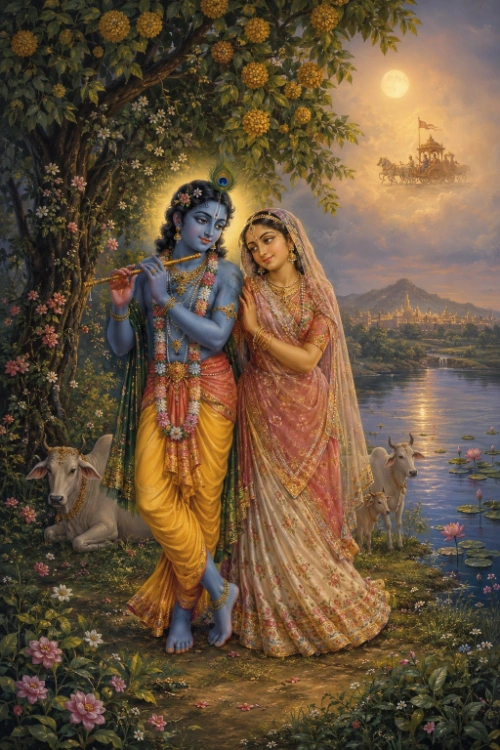
Kṛṣṇa Never Leaves Vṛndāvana: The Eternal Identity of Vrajendra-nandana
Among the most consequential statements in Gauḍīya Vaiṣṇava theology is Śrī Rūpa Gosvāmī’s declaration that the original Kṛṣṇa never leaves Vṛndāvana. Taken flatly it appears to contradict the Bhāgavatam, which narrates Kṛṣṇa’s departure for Mathurā in detail and at length. Taken precisely, it is not a claim about where Kṛṣṇa is. It is a claim about who he is.
The Foundational Verse
कृष्णोऽन्यो यदुसम्भूतो यः पूर्णः सोऽस्त्यतः परः ।
वृन्दावनं परित्यज्य स क्वचिन्नैव गच्छति ॥
kṛṣṇo ’nyo yadu-sambhūto yaḥ pūrṇaḥ so ’sty ataḥ paraḥ
vṛndāvanaṁ parityajya sa kvacin naiva gacchati
“The Kṛṣṇa born in the Yadu dynasty is another; he who is pūrṇa is distinct from and beyond that one. Abandoning Vṛndāvana, he never at any time goes anywhere.” — Rūpa Gosvāmī, Laghu-bhāgavatāmṛta, quoted at Śrī Caitanya-caritāmṛta, Antya-līlā 1.67
On the reference. Kṛṣṇadāsa Kavirāja gives no source; the attribution comes from the commentators, and they do not agree on the numbering. The Bhaktivedanta purport to Antya 1.67 gives Laghu-bhāgavatāmṛta 1.5.461; Śrī Gauḍīya-kaṇṭhahāra 7.42 gives Pūrva-khaṇḍa 165. These are two conventions for numbering the same work rather than two different verses. Cite it as “Laghu-bhāgavatāmṛta 1.5.461 (Pūrva-khaṇḍa 165 in other reckonings), quoted at Caitanya-caritāmṛta, Antya-līlā 1.67,” and the reader can find it in either edition.
The verse states a mystery rather than resolving one. The Śrīmad-Bhāgavatam narrates without ambiguity that Kṛṣṇa leaves Vraja for Mathurā and later rules at Dvārakā. Rūpa Gosvāmī declares that the complete, original Kṛṣṇa never departs Vṛndāvana at all. Gauḍīya theology does not treat these as competing accounts. They describe different dimensions of one simultaneously manifest identity, and the machinery for holding them together is set out below.
A Careful Translation
The first half of the verse carries the doctrine, and it is the half most often dropped when the verse is quoted.
The word anyaḥ does not posit two unrelated deities. It distinguishes two manifestations of one indivisible Supreme Person — Kṛṣṇa as Vrajendra-nandana, the son of Nanda and Yaśodā, and Kṛṣṇa as Vāsudeva or Yadu-kumāra, the son of Vasudeva and Devakī. Likewise paraḥ marks a distinction in the mode and fullness of manifestation. It does not imply that the Vāsudeva form is mundane, deficient in any ordinary sense, or separate from Bhagavān. Exactly what kind of distinction is meant is a technical question with a technical answer, given further below.
The Dream at Satyabhāmā-pura
The verse reaches us inside a narrative, and the narrative is about writing plays. Travelling to Jagannātha Purī, Rūpa Gosvāmī stopped for a night in an Orissan village:
উড়িয়া-দেশে ‘সত্যভামাপুর’-নামে গ্রাম ।
এক রাত্রি সেই গ্রামে করিলা বিশ্রাম ॥ ৪০ ॥
রাত্রে স্বপ্নে দেখে, — এক দিব্যরূপা নারী ।
সম্মুখে আসিয়া আজ্ঞা দিলা বহু কৃপা করি’ ॥ ৪১ ॥
uḍiyā-deśe ‘satyabhāmā-pura’-nāme grāma
eka rātri sei grāme karilā viśrāma
rātre svapne dekhe, — eka divya-rūpā nārī
sammukhe āsiyā ājñā dilā bahu kṛpā kari’
“In Orissa there is a village named Satyabhāmā-pura; he rested there one night. At night he saw in a dream a woman of divine form, who came before him and, showing great mercy, gave an order.” — Caitanya-caritāmṛta, Antya-līlā 1.40–41
আমার নাটক পৃথক্ করহ রচন ।
আমার কৃপাতে নাটক হৈবে বিলক্ষণ ॥ ৪২ ॥
āmāra nāṭaka pṛthak karaha racana
āmāra kṛpāte nāṭaka haibe vilakṣaṇa
“‘Compose my drama separately. By my mercy the drama will turn out extraordinary.’” — Caitanya-caritāmṛta, Antya-līlā 1.42
The text is careful in a way that summaries usually are not. At 1.41 she is simply eka divya-rūpā nārī, “a woman of divine form”; she is not named. It is Rūpa Gosvāmī who identifies her, on waking, at 1.43 — satyabhāmāra ājñā, “the order of Satyabhāmā.” The recognition is his inference, and the narrative reports it as such.
Mahāprabhu’s Instruction at Purī
At Jagannātha Purī the dream was confirmed from an unexpected direction. The narrator opens the Lord’s speech at 1.65 — sarvajña-śiromaṇi prabhu kahite lāgilā, “the crest jewel of the omniscient began to speak” — and what he says is this:
কৃষ্ণেরে বাহির নাহি করিহ ব্রজ হৈতে ।
ব্রজ ছাড়ি’ কৃষ্ণ কভু না যান কাহাঁতে ॥ ৬৬ ॥
kṛṣṇere bāhira nāhi kariha vraja haite
vraja chāḍi’ kṛṣṇa kabhu nā yāna kāhāṅte
“Do not take Kṛṣṇa outside of Vraja. Leaving Vraja, Kṛṣṇa never goes anywhere at any time.” — Caitanya-caritāmṛta, Antya-līlā 1.66
The Sanskrit verse quoted at the head of this article follows immediately, as 1.67 — and it is worth establishing that it is spoken by Mahāprabhu himself rather than adduced by Kṛṣṇadāsa as a proof-text of his own. The brackets settle it. The Lord’s speech opens at 1.65 with kahite lāgilā and closes at 1.68 with eta kahi’ mahāprabhu madhyāhne calilā — “having said this, Mahāprabhu left for his noon duties, and Rūpa Gosvāmī’s mind was somewhat astonished.” No narratorial tag intervenes between 1.66 and 1.67. Mahāprabhu is quoting Rūpa Gosvāmī’s own verse back to him, and Rūpa’s reaction at 1.69 treats it as an instruction directed at him personally.
পৃথক্ নাটক করিতে সত্যভামা আজ্ঞা দিল ।
জানিলু, পৃথক্ নাটক করিতে প্রভু-আজ্ঞা হৈল ॥ ৬৯ ॥
পূর্বে দুই নাটক ছিল একত্র রচনা ।
দুইভাগ করি এবে করিমু ঘটনা ॥ ৭০ ॥
দুই ‘নান্দী’ ‘প্রস্তাবনা’, দুই ‘সংঘটনা’ ।
পৃথক্ করিয়া লিখি করিয়া ভাবনা ॥ ৭১ ॥
pṛthak nāṭaka karite satyabhāmā ājñā dila
jānilu, pṛthak nāṭaka karite prabhu-ājñā haila
pūrve dui nāṭaka chila ekatra racanā
dui-bhāga kari ebe karimu ghaṭanā
dui ‘nāndī’ ‘prastāvanā’, dui ‘saṁghaṭanā’
pṛthak kariyā likhi kariyā bhāvanā
“Satyabhāmā ordered me to make a separate drama; now I know that the Lord’s order to make a separate drama has come. Formerly the two dramas were composed as one; now, making two parts, I shall arrange the incidents — two benedictory verses, two prologues, two plots — writing them separately after due reflection.” — Caitanya-caritāmṛta, Antya-līlā 1.69–71
The two works are Vidagdha-mādhava, given entirely to the Vṛndāvana pastimes, and Lalita-mādhava, which carries the līlā through Mathurā and Dvārakā while keeping its bond with Vraja in view. The division is not a matter of literary convenience. It preserves in dramatic form the distinction the verse states in doctrinal form.
A small point of accuracy. Verses 1.69–71 do not name either play; Rūpa speaks only of “two dramas.” The titles come from the commentators and from the later course of the chapter, and should not be presented as if the passage supplied them.
One Kṛṣṇa, Two Manifestations
Vraja-Kṛṣṇa and Vāsudeva-Kṛṣṇa are not different in the way one person differs from another. Both are Kṛṣṇa; both are viṣṇu-tattva, the one undivided divine reality. What differs is the form in which his personality, his relationships and his sweetness become manifest.
The Precise Category: Vaibhava-prakāśa
“Expansion” is too loose a word here, and using it invites the reader to imagine a derived or secondary being. Kṛṣṇadāsa Kavirāja’s taxonomy in the twentieth chapter of the Madhya-līlā is exact, and it places Devakī’s son with precision. He begins with the three primary divisions:
স্বয়ংরূপ, তদেকাত্মরূপ, আবেশ — নাম ।
প্রথমেই তিনরূপে রহেন ভগবান্ ॥ ১৬৫ ॥
‘স্বয়ংরূপ’ ‘স্বয়ংপ্রকাশ,’ — দুই রূপে স্ফূর্তি ।
স্বয়ংরূপে — এক ‘কৃষ্ণ’ ব্রজে গোপমূর্তি ॥ ১৬৬ ॥
svayaṁ-rūpa, tad-ekātma-rūpa, āveśa — nāma
prathamei tina-rūpe rahena bhagavān
‘svayaṁ-rūpa’ ‘svayaṁ-prakāśa’ — dui rūpe sphūrti
svayaṁ-rūpe — eka ‘kṛṣṇa’ vraje gopa-mūrti
“Bhagavān abides primarily in three forms, named svayaṁ-rūpa, tad-ekātma-rūpa and āveśa. The svayaṁ-rūpa shines forth in two modes, svayaṁ-rūpa and svayaṁ-prakāśa; as svayaṁ-rūpa there is the one Kṛṣṇa, the cowherd figure in Vraja.” — Caitanya-caritāmṛta, Madhya-līlā 20.165–166
This is the fork that matters. A vilāsa or a svāṁśa belongs to the second category, tad-ekātma-rūpa — a form distinct in identity though non-different in tattva. A prakāśa belongs to the first: it is the svayaṁ-rūpa itself, self-manifested. And Devakī’s son is named as the paradigm case of prakāśa, not of vilāsa:
বৈভবপ্রকাশ যৈছে দেবকী-তনুজ ।
দ্বিভুজ-স্বরূপ কভু, কভু হয় চতুর্ভুজ ॥ ১৭৫ ॥
যে-কালে দ্বিভুজ, নাম — বৈভবপ্রকাশ ।
চতুর্ভুজ হৈলে, নাম — প্রাভবপ্রকাশ ॥ ১৭৬ ॥
স্বয়ংরূপের গোপবেশ, গোপ-অভিমান ।
বাসুদেবের ক্ষত্রিয়-বেশ, ‘আমি — ক্ষত্রিয়’-জ্ঞান ॥ ১৭৭ ॥
vaibhava-prakāśa yaiche devakī-tanuja
dvibhuja-svarūpa kabhu, kabhu haya caturbhuja
ye-kāle dvibhuja, nāma — vaibhava-prakāśa
caturbhuja haile, nāma — prābhava-prakāśa
svayaṁ-rūpera gopa-veśa, gopa-abhimāna
vāsudevera kṣatriya-veśa, ‘āmi — kṣatriya’-jñāna
“An instance of vaibhava-prakāśa is the son of Devakī: sometimes his form is two-armed, sometimes it becomes four-armed. When two-armed, the name is vaibhava-prakāśa; when four-armed, prābhava-prakāśa. The svayaṁ-rūpa has a cowherd’s dress and a cowherd’s self-conception; Vāsudeva has a kṣatriya’s dress and the knowledge ‘I am a kṣatriya.’” — Caitanya-caritāmṛta, Madhya-līlā 20.175–177
This is the exact content of Rūpa Gosvāmī’s anyaḥ. The difference between the two is a difference of veśa and abhimāna — of dress and of self-conception — within one and the same original person. It is not a difference of tattva, and it is not a difference between an original and a derivative. That is why the verse can say “another” without positing a second God, and it is why the Bhāgavatam’s narrative of departure and the theologian’s denial of departure can both stand.
One trap to avoid, and it is the standard error in popular treatments of this subject. There is a second Vāsudeva in the same chapter — the first member of the catur-vyūha (Vāsudeva, Saṅkarṣaṇa, Pradyumna, Aniruddha). That Vāsudeva belongs to tad-ekātma-rūpa and is a prābhava-vilāsa, and Kṛṣṇadāsa says of the four that kṛṣṇera ei cāri prābhava-vilāsa / dvārakā-mathurā-pure nitya iṅhāra vāsa — “these four prābhava pastime forms of Kṛṣṇa reside eternally in Dvārakā and Mathurā” (Madhya 20.190). The shared place-names are what cause the confusion. The son of Vasudeva and Devakī is a prakāśa; the first of the catur-vyūha is a vilāsa. Anyone writing “Vāsudeva” in this context should say which one is meant.
Lamp from Lamp
Because the Absolute is unlimited, Kṛṣṇa manifests in innumerable forms and places without being divided or diminished. A manifestation is not a fragment cut away from an original; each divine form is fully conscious and wholly spiritual. The Brahma-saṁhitā gives the classical image:
दीपार्चिरेव हि दशान्तरमभ्युपेत्य
दीपायते विवृतहेतुसमानधर्मा ।
यस्तादृगेव हि च विष्णुतया विभाति
गोविन्दमादिपुरुषं तमहं भजामि ॥
dīpārcir eva hi daśāntaram abhyupetya
dīpāyate vivṛta-hetu-samāna-dharmā
yas tādṛg eva hi ca viṣṇutayā vibhāti
govindam ādi-puruṣaṁ tam ahaṁ bhajāmi
“As the flame of a lamp, passing to another wick, burns there with the same properties as its evident source, so does he shine forth in the mode of Viṣṇu. I worship Govinda, the primeval Person.” — Brahma-saṁhitā 5.46
The analogy carries the essential point — no diminution in the source, no inferiority in what is kindled — but Gauḍīya theology goes past it. Flames are interchangeable; these manifestations are not. Each possesses an eternally distinct form, mood, circle of associates and body of pastimes, and it is precisely that distinctness which the verse under discussion is asserting.
Kṛṣṇa Is Svayaṁ Bhagavān
The scriptural ground for treating the Vraja form as original is the Bhāgavatam’s own summary of the avatāras:
एते चांशकलाः पुंसः कृष्णस्तु भगवान् स्वयम् ।
इन्द्रारिव्याकुलं लोकं मृडयन्ति युगे युगे ॥ २८ ॥
ete cāṁśa-kalāḥ puṁsaḥ kṛṣṇas tu bhagavān svayam
indrāri-vyākulaṁ lokaṁ mṛḍayanti yuge yuge
“All these are portions and portions of portions of the Puruṣa, but Kṛṣṇa is Bhagavān himself. Age after age they bring relief to a world troubled by the enemies of Indra.” — Śrīmad-Bhāgavatam 1.3.28
The clause kṛṣṇas tu bhagavān svayam is the hinge of the whole Gauḍīya reading of the Bhāgavatam. The particle tu sets Kṛṣṇa apart from the list just given: he is not one avatāra among many but the source from whom the others proceed. Mahāprabhu opens his instruction to Sanātana Gosvāmī by locating that source in Vraja:
কৃষ্ণের স্বরূপ-বিচার শুন, সনাতন ।
অদ্বয়জ্ঞান-তত্ত্ব, ব্রজে ব্রজেন্দ্রনন্দন ॥ ১৫২ ॥
সর্ব-আদি, সর্ব-অংশী, কিশোর-শেখর ।
চিদানন্দ-দেহ, সর্বাশ্রয়, সর্বেশ্বর ॥ ১৫৩ ॥
kṛṣṇera svarūpa-vicāra śuna, sanātana
advaya-jñāna-tattva, vraje vrajendra-nandana
sarva-ādi, sarva-aṁśī, kiśora-śekhara
cid-ānanda-deha, sarvāśraya, sarveśvara
“Hear the consideration of Kṛṣṇa’s own form, Sanātana: the reality of non-dual knowledge, in Vraja the son of the king of Vraja — the origin of all, the whole of whom all are parts, the crown of youth, his body consciousness and bliss, the shelter of all and the Lord of all.” — Caitanya-caritāmṛta, Madhya-līlā 20.152–153
The same chapter that supplies the taxonomy therefore also supplies the ranking, and a verse from the twenty-first chapter states the dependence in the sharpest possible terms:
সেইরূপ ব্রজাশ্রয়, ঐশ্বর্য-মাধুর্যময়,
দিব্যগুণগণ-রত্নালয় ।
আনের বৈভব-সত্তা, কৃষ্ণদত্ত ভগবত্তা,
কৃষ্ণ — সর্ব-অংশী, সর্বাশ্রয় ॥ ১২০ ॥
sei-rūpa vrajāśraya, aiśvarya-mādhuryamaya,
divya-guṇa-gaṇa-ratnālaya
ānera vaibhava-sattā, kṛṣṇa-datta bhagavattā,
kṛṣṇa — sarva-aṁśī, sarvāśraya
“That form has Vraja for its shelter, is made of majesty and sweetness, and is a jewel-mine of divine qualities. The very existence of others’ opulence, their godhood itself, is given by Kṛṣṇa; Kṛṣṇa is the whole of whom all are parts, the shelter of all.” — Caitanya-caritāmṛta, Madhya-līlā 21.120
This is the doctrine read from the other end. It is not merely that the Vraja form ranks highest on some scale of sweetness; the godhood of every other divine form is kṛṣṇa-datta, bestowed by him. That is the paradoxical beauty of Vraja-Kṛṣṇa: the one from whom all divinity derives does not appear there as a source of divinity at all. He appears as Nanda’s son, Yaśodā’s troublesome child, the companion of the cowherd boys and the beloved of Śrī Rādhā.
Why Vraja-Kṛṣṇa Is Called “Complete”
The pūrṇaḥ of Rūpa Gosvāmī’s verse means full or complete. It does not suggest that Kṛṣṇa’s other forms lack divinity — an impossibility, since divinity is not a quantity he can run short of. It means that Vraja manifests the fullest range of his personal qualities and intimate relationships. His powers are unlimited in every manifestation; what varies is how much of his person becomes visible, and to whom.
In Mathurā and Dvārakā his associates know more clearly that he is the Supreme Lord, and their love is accordingly interwoven with reverence, royal dignity and awareness of his majesty. In Vraja that awareness recedes behind intimacy:
- Yaśodā does not worship him as the almighty creator; she worries that he has not eaten enough.
- Nanda does not approach him as the Supreme Lord; he regards Kṛṣṇa as his dependent son.
- The cowherd boys keep no reverential distance; they wrestle with him, beat him at games and ride on his shoulders.
- The gopīs do not relate to a remote God; their love is intimate enough to reproach him, command him and refuse him.
- Śrī Rādhā’s love is so complete that Kṛṣṇa is conquered by it.
Vraja does not lack divine majesty. Its majesty is concealed and surpassed by mādhurya, intimate sweetness.
Sweetness Is the Essence of Divinity
The Caitanya-caritāmṛta does not treat sweetness as an attractive addition to godhood. It calls sweetness godhood’s essence:
মাধুর্য ভগবত্তা-সার, ব্রজে কৈল পরচার,
তাহা শুক — ব্যাসের নন্দন ।
স্থানে স্থানে ভাগবতে, বর্ণিয়াছে জানাইতে,
তাহা শুনি’ মাতে ভক্তগণ ॥ ১১০ ॥
mādhurya bhagavattā-sāra, vraje kaila paracāra,
tāhā śuka — vyāsera nandana
sthāne sthāne bhāgavate, varṇiyāche jānāite,
tāhā śuni’ māte bhakta-gaṇa
“Sweetness is the essence of godhood, and he broadcast it in Vraja; Śuka, the son of Vyāsa, has described it place after place in the Bhāgavatam to make it known, and hearing it the devotees become intoxicated.” — Caitanya-caritāmṛta, Madhya-līlā 21.110
The reading is paracāra, not pracāra; the printed text and its word-for-word gloss agree, and the form should not be silently normalised. The verse is in tripadī metre and is properly set in four short lines rather than two long ones.
মধুরৈশ্বর্য-মাধুর্য-কৃপাদি-ভাণ্ডার ।
যোগমায়া দাসী যাহাঁ রাসাদি লীলা-সার ॥ ৪৪ ॥
madhuraiśvarya-mādhurya-kṛpādi-bhāṇḍāra
yogamāyā dāsī yāhāṅ rāsādi līlā-sāra
“A treasury of sweet opulence, of sweetness, of mercy and the rest — where Yogamāyā is the maidservant, and where the rāsa and the other quintessential pastimes are.” — Caitanya-caritāmṛta, Madhya-līlā 21.44
Vraja is not supreme because Kṛṣṇa exercises greater power there. It is supreme because his power is so completely subordinated to love.
The Supreme Brahman Becomes the Friend of Cowherds
Brahmā, having tested Kṛṣṇa by stealing the boys and calves and having been comprehensively answered, does not conclude his prayers by praising Kṛṣṇa’s power. He praises the luck of the villagers:
अहो भाग्यमहो भाग्यं नन्दगोपव्रजौकसाम् ।
यन्मित्रं परमानन्दं पूर्णं ब्रह्म सनातनम् ॥ ३२ ॥
aho bhāgyam aho bhāgyaṁ nanda-gopa-vrajaukasām
yan-mitraṁ paramānandaṁ pūrṇaṁ brahma sanātanam
“What fortune, what fortune belongs to Nanda the cowherd and the residents of Vraja — whose friend is the supreme bliss, the complete and eternal Brahman!” — Śrīmad-Bhāgavatam 10.14.32, from Brahmā’s prayers
The verse does not say that the residents of Vraja understand Brahman. It says that Brahman has become their mitra, their friend. Śukadeva registers the same astonishment while describing Kṛṣṇa eating lunch on the riverbank with the boys:
इत्थं सतां ब्रह्मसुखानुभूत्या दास्यं गतानां परदैवतेन ।
मायाश्रितानां नरदारकेण साकं विजह्रुः कृतपुण्यपुञ्जाः ॥ ११ ॥
itthaṁ satāṁ brahma-sukhānubhūtyā dāsyaṁ gatānāṁ para-daivatena
māyāśritānāṁ nara-dārakeṇa sākaṁ vijahruḥ kṛta-puṇya-puñjāḥ
“Thus those who had amassed heaps of merit sported together with him who, for the saintly, is the experience of the bliss of Brahman; who, for those who have taken to service, is the Supreme Deity; and who, for those sheltered by māyā, is a human child.” — Śrīmad-Bhāgavatam 10.12.11 (printed in the Bhaktivedanta edition within the block 10.12.7–11)
The marvel of Vraja is not that its residents fail to notice Kṛṣṇa’s greatness. It is that their love is strong enough that his greatness no longer obstructs intimacy.
Yaśodā Receives What Even Brahmā Does Not
नेमं विरिञ्चो न भवो न श्रीरप्यङ्गसंश्रया ।
प्रसादं लेभिरे गोपी यत्तत्प्राप विमुक्तिदात् ॥ २० ॥
nemaṁ viriñco na bhavo na śrīr apy aṅga-saṁśrayā
prasādaṁ lebhire gopī yat tat prāpa vimuktidāt
“Neither Brahmā, nor Śiva, nor even Śrī who rests upon his chest, obtained such mercy from the giver of liberation as the cowherd woman obtained.” — Śrīmad-Bhāgavatam 10.9.20
The gopī of this verse is mother Yaśodā, not one of the gopīs of the rāsa — a distinction worth holding, since the verse is frequently misapplied. Her apparent ignorance of Kṛṣṇa’s divinity is not a spiritual deficiency; it is the perfection of vātsalya-rasa. God becomes subordinate to his devotee not because his divinity lapses, but because divine love is itself one of his highest powers.
Uddhava’s Prayer
The most telling external testimony comes from Kṛṣṇa’s own envoy. Sent from Mathurā to console the gopīs, Uddhava — learned, poised, a student of Bṛhaspati — ends by abandoning his errand’s premise altogether:
आसामहो चरणरेणुजुषामहं स्यां
वृन्दावने किमपि गुल्मलतौषधीनाम् ।
या दुस्त्यजं स्वजनमार्यपथं च हित्वा
भेजुर्मुकुन्दपदवीं श्रुतिभिर्विमृग्याम् ॥ ६१ ॥
āsām aho caraṇa-reṇu-juṣām ahaṁ syāṁ
vṛndāvane kim api gulma-latauṣadhīnām
yā dustyajaṁ sva-janam ārya-pathaṁ ca hitvā
bhejur mukunda-padavīṁ śrutibhir vimṛgyām
“Ah, let me be some bush, creeper or herb in Vṛndāvana, that I might serve the dust of the feet of these women — who abandoned what is hardest to abandon, their own people and the path of the respectable, and took to the way of Mukunda that the Vedas search for.” — Śrīmad-Bhāgavatam 10.47.61
Uddhava does not pray to be a gopī, which would be presumption; he prays to be vegetation in the place where they walk. The prayer is a statement about the ranking of realms made from inside the Dvārakā party, and it is all the more forceful for that.
Goloka and the All-Pervading Lord
The metaphysical frame that permits Kṛṣṇa to be in Goloka and everywhere at once is given in a single line of the Brahma-saṁhitā:
आनन्दचिन्मयरसप्रतिभाविताभिस्
ताभिर्य एव निजरूपतया कलाभिः ।
गोलोक एव निवसत्यखिलात्मभूतो
गोविन्दमादिपुरुषं तमहं भजामि ॥
ānanda-cinmaya-rasa-pratibhāvitābhis
tābhir ya eva nija-rūpatayā kalābhiḥ
goloka eva nivasaty akhilātma-bhūto
govindam ādi-puruṣaṁ tam ahaṁ bhajāmi
“He who dwells in Goloka alone, together with those who are his own form in its parts, saturated with the rasa of conscious bliss — and who is at the same time the self of all: I worship Govinda, the primeval Person.” — Brahma-saṁhitā 5.37
The construction is the argument. Goloka eva nivasati — “he dwells in Goloka, and there specifically” — stands in the same sentence as akhilātma-bhūtaḥ, “having become the self of everything.” These are not held to be in tension:
A Purāṇic Anchor Outside the Gauḍīya Corpus
The doctrine is not confined to the Gosvāmīs. The Vṛndāvana-māhātmya section of the Padma Purāṇa’s Pātāla-khaṇḍa states it in nearly the same shape as Rūpa Gosvāmī’s verse, and states it more bluntly:
वृन्दावनपरित्यागो गोविन्दस्य न विद्यते ।
अन्यत्र यद्वपुस्तत्तु कृत्रिमं तन्न संशयः ॥
vṛndāvana-parityāgo govindasya na vidyate
anyatra yad vapus tat tu kṛtrimaṁ tan na saṁśayaḥ
“Govinda has no abandoning of Vṛndāvana; whatever body is elsewhere, that is fashioned — of this there is no doubt.” — Padma Purāṇa, Pātāla-khaṇḍa 77.61
Two remarks are needed. First on the word kṛtrima, which is sometimes rendered “illusory.” That is wrong, and theologically it would be disastrous: it would make the Dvārakā Kṛṣṇa a product of māyā, which no Vaiṣṇava school holds. Kṛtrima means made, fashioned, constructed — and read against the Caitanya-caritāmṛta’s taxonomy it points exactly to a prakāśa, a form self-manifested for the purposes of a particular līlā. Rūpa’s anyaḥ and the Purāṇa’s kṛtrima are doing the same work. Second, the same khaṇḍa carries the statement in Kṛṣṇa’s own mouth, in a discourse to Rudra: he never leaves Vṛndāvana and goes elsewhere, and dwells there always with Rādhikā (Pātāla-khaṇḍa 82).
On a line that will not be found here. Readers will know the aphorism vṛndāvanaṁ parityajya padam ekaṁ na gacchati, “abandoning Vṛndāvana he does not go one step,” usually introduced as Purāṇic and variously assigned to the Ādi Purāṇa, the Nārada-pañcarātra or the Bṛhad-vāmana Purāṇa. No such attribution can be secured, and the wording does not correspond to Rūpa Gosvāmī’s verse, which reads sa kvacin naiva gacchati. A first-person form, na gacchāmi, also circulates; the doctrine does appear in the first person in Pātāla-khaṇḍa 82, but that particular hemistich is untraced. The aphorism is best cited as a traditional saying with no source attached — and it has a further defect, in that it preserves only the second line of Rūpa’s couplet and drops the first, which is the line that carries the doctrine and dissolves the apparent contradiction.
But Did Kṛṣṇa Not Visibly Leave Vraja?
He did, and the Bhāgavatam does not soften it. Akrūra’s chariot comes; Kṛṣṇa and Balarāma board it; the gopīs are left in the road. Their words are given at length, and then:
श्रीशुक उवाच
एवं ब्रुवाणा विरहातुरा भृशं
व्रजस्त्रियः कृष्णविषक्तमानसाः ।
विसृज्य लज्जां रुरुदुः स्म सुस्वरं
गोविन्द दामोदर माधवेति ॥ ३१ ॥
śrī-śuka uvāca
evaṁ bruvāṇā virahāturā bhṛśaṁ
vraja-striyaḥ kṛṣṇa-viṣakta-mānasāḥ
visṛjya lajjāṁ ruruduḥ sma su-svaraṁ
govinda dāmodara mādhaveti
“Śuka said: Speaking so, the women of Vraja, their minds fastened to Kṛṣṇa and sorely afflicted by the coming separation, cast off shame and wept aloud: ‘Govinda! Dāmodara! Mādhava!’” — Śrīmad-Bhāgavatam 10.39.31
And then they do not move:
यावदालक्ष्यते केतुर्यावद् रेणू रथस्य च ।
अनुप्रस्थापितात्मानो लेख्यानीवोपलक्षिताः ॥ ३६ ॥
yāvad ālakṣyate ketur yāvad reṇū rathasya ca
anuprasthāpitātmāno lekhyānīvopalakṣitāḥ
“Having sent their very selves after him, they appeared like figures in a painting — for as long as the banner could be seen, and as long as the chariot’s dust.” — Śrīmad-Bhāgavatam 10.39.36
The departure is therefore experientially real, and the grief of the Vraja devotees is not a misunderstanding to be corrected by theology. Any account of “Kṛṣṇa never leaves Vṛndāvana” that makes those verses false has failed.
Three Levels of the Apparent Departure
The apparent contradiction resolves once three distinct levels are kept apart.
Kṛṣṇadāsa states the priority between the last two plainly elsewhere: ataeva goloka-sthāne nitya vihāra / brahmāṇḍa-gaṇe krame prākaṭya tāhāra — “therefore the sporting is eternal in the place called Goloka; its becoming manifest occurs by turns among the universes” (Madhya-līlā 20.397). The visible līlā is the appearing of something that was never interrupted, not a substitute for it.
Separation Is Not the Absence of Relationship
If Kṛṣṇa eternally remains in Vṛndāvana, why do Rādhā and the gopīs suffer so terribly? Because viraha is not the negation of love but one of its most concentrated forms. When Kṛṣṇa is externally absent, every feature of Vraja recalls him; memory becomes continuous; longing burns away the last residue of self-interest; he becomes more intensely present within consciousness; and love expands past the limits that direct association imposes on it.
This is not an argument that suffering is good. The suffering of separation is spiritually unique because of what produces it — an intensity of love with no parallel — not because pain has value in itself. The gopīs themselves describe the transformation of time it works:
यस्यानुरागललितस्मितवल्गुमन्त्र-
लीलावलोकपरिरम्भणरासगोष्ठाम् ।
नीताः स्म नः क्षणमिव क्षणदा विना तं
गोप्यः कथं न्वतितरेम तमो दुरन्तम् ॥ २९ ॥
yasyānurāga-lalita-smita-valgu-mantra-
līlāvaloka-parirambhaṇa-rāsa-goṣṭhām
nītāḥ sma naḥ kṣaṇam iva kṣaṇadā vinā taṁ
gopyaḥ kathaṁ nv atitarema tamo durantam
“In whose assembly of the rāsa — his loving tender smiles, his charming secret words, his playful glances, his embraces — our nights passed as though a single moment: without him, gopīs, how shall we cross this darkness that has no end?” — Śrīmad-Bhāgavatam 10.39.29
In union a whole night becomes a moment; in separation a moment becomes endless. The measure of their absorption is written in the elasticity of their time.
Kṛṣṇa Also Suffers in Separation
The separation is not one-sided, and the Caitanya-caritāmṛta gives Kṛṣṇa’s side of it. In the thirteenth chapter of the Madhya-līlā, during the Ratha-yātrā, Mahāprabhu is absorbed in the meeting of Rādhā and Kṛṣṇa at Kurukṣetra and voices both parties in turn. Verses 13.126–147 are Rādhā’s appeal that Kṛṣṇa return to Vṛndāvana; 13.148 marks the turn — śuniyā rādhikā-vāṇī, vraja-prema mane āni, bhāve vyākulita deha-mana, “hearing Rādhikā’s words, bringing Vraja-prema to mind, his body and mind were agitated with feeling” — and what follows is Kṛṣṇa’s answer:
প্রাণপ্রিয়ে, শুন, মোর এ-সত্য-বচন ।
তোমা-সবার স্মরণে, ঝুরোঁ মুঞি রাত্রিদিনে,
মোর দুঃখ না জানে কোন জন ॥ ১৪৯ ॥
prāṇa-priye, śuna, mora e-satya-vacana
tomā-sabāra smaraṇe, jhuroṅ muñi rātri-dine,
mora duḥkha nā jāne kona jana
“Beloved of my life, hear this true word of mine: remembering all of you, I weep night and day, and no one knows my sorrow.” — Caitanya-caritāmṛta, Madhya-līlā 13.149
The speaker here is Kṛṣṇa addressing Rādhā, not Rādhā addressing Kṛṣṇa — a distinction frequently lost in retellings, and one that reverses the verse’s whole force. The next verse continues in the same voice: the residents of Vraja are all as dear to him as his own life, and among the gopīs, Rādhā is jīvanera jīvana, the life of his life (13.150).
Royal surroundings, family, wealth and sovereignty at Dvārakā do not substitute for Vraja. The flute, the Yamunā, Govardhana, the forest bowers, the cows, the cowherd boys, Nanda, Yaśodā and above all Śrī Rādhā belong to Kṛṣṇa’s innermost identity. His heart does not leave Vṛndāvana because Vṛndāvana is not merely where he lives. It is the fullest disclosure of who he is.
Vṛndāvana Is More Than a Place
The word operates on several interconnected levels at once.
Earthly Vṛndāvana is not a symbolic representation of Goloka. In the Gauḍīya understanding it is the manifestation of that same transcendental dhāma within terrestrial space, its nature veiled from ordinary material vision. “Kṛṣṇa never leaves Vṛndāvana” therefore does not mean that he remains sentimentally attached to a childhood home. It means he never abandons his identity as Vrajendra-nandana, his eternal youthful form, his flute, his cowherd relationships, his intimate associates, his līlā with Śrī Rādhā, or the supreme sweetness of Vraja-prema.
Vraja-Kṛṣṇa Is Not Merely the “Young Kṛṣṇa”
A common misreading treats Vraja as the childhood chapter of a biography: Kṛṣṇa is born, grows up in Vṛndāvana, leaves for Mathurā, becomes a prince, and finally rules Dvārakā. As a description of the surface sequence of the manifest narrative that is unobjectionable. As theology it inverts the tradition.
Vraja-Kṛṣṇa is not an immature stage that Kṛṣṇa outgrows. His identity as the youthful cowherd is eternal — he is kiśora-śekhara, the crown of ever-fresh youth (Madhya 20.153). His royal identities do not supersede his Vraja identity; they coexist with it as manifestations of one unlimited person. The movement from Vṛndāvana to Mathurā is thus not a progression from a lesser to a greater Kṛṣṇa. On the Gauḍīya reading the opposite is nearer the truth: what is fullest in Kṛṣṇa is most completely disclosed in Vraja.
Majesty and Sweetness
Kṛṣṇa possesses both everywhere; only their prominence shifts. In Vaikuṇṭha, reverence for majesty predominates. In Dvārakā he is a royal person among palaces, queens and Yādava heroes. In Mathurā he is recognised as Vasudeva and Devakī’s son and the destroyer of Kaṁsa. In Vraja, majesty is concealed beneath sweetness, and he appears to depend on those who love him.
That concealment is not a reduction of divinity but a greater exercise of it. Any omnipotent being can display power. Only the highest manifestation of Bhagavān can let his omnipotence be forgotten so completely that his devotees bind him, defeat him, feed him, protect him, scold him and enchant him. Vṛndāvana is not devoid of aiśvarya; it holds inconceivable opulence, but there the opulence serves intimacy instead of overwhelming it.
The Position of Śrī Rādhā
At the centre of Kṛṣṇa’s eternal residence in Vṛndāvana is Śrī Rādhā. Vṛndāvana is the realm in which her love reaches its fullest expression and in which Kṛṣṇa is most completely conquered. His identity as Rādhā’s beloved is not a pastime appended to a pre-existing divinity; for Gauḍīya Vaiṣṇavas it belongs to the deepest disclosure of the Absolute.
The Brahma-saṁhitā verse quoted above describes Kṛṣṇa’s associates as saturated with the rasa of conscious bliss and as his own form in its parts. They are not conditioned souls cast in temporary roles; Śrī Rādhā and the eternal residents of Vraja belong to Kṛṣṇa’s own spiritual reality. It follows that Kṛṣṇa’s eternal presence in Vṛndāvana is also a statement about his relationship with Rādhā: it is beginningless, uninterrupted, and not replaceable by his relationships elsewhere. The queens of Dvārakā are exalted eternal associates, but they participate in a different manifestation of love — shaped by marriage, royal life and awareness of his sovereignty. Rādhā’s Vraja-prema is unrestrained by any such consciousness.
What “Another Kṛṣṇa” Does Not Mean
Rūpa Gosvāmī’s anyaḥ must not be read to mean any of the following:
- that Vāsudeva-Kṛṣṇa is a created being;
- that the Kṛṣṇa of Dvārakā is not Bhagavān;
- that two independent supreme beings exist;
- that the Mathurā and Dvārakā pastimes are unreal;
- that the departure narrated in the Bhāgavatam does not occur within the manifest līlā;
- that the devotees’ separation is imagined;
- or that Vraja-Kṛṣṇa is geographically confined and therefore unable to manifest elsewhere.
What it does mean can be stated as a series:
- Kṛṣṇa is one indivisible Absolute Reality.
- He possesses unlimited eternal manifestations.
- These differ in form, dress, self-conception, mood, associates and līlā.
- The original and fullest is Vrajendra-nandana, the svayaṁ-rūpa.
- The Mathurā and Dvārakā pastimes are conducted by his vaibhava-prakāśa, the son of Vasudeva and Devakī.
- The original two-armed cowherd Kṛṣṇa remains eternally in Vṛndāvana.
- His Vraja identity is never dissolved into his royal identities.
On what this article does not claim. The reading given here is Kṛṣṇadāsa Kavirāja’s, drawn from Madhya-līlā 20 and 21. Whether Jīva Gosvāmī takes up the “two Kṛṣṇas” objection directly in the Kṛṣṇa-sandarbha, and how Rūpa Gosvāmī frames the verse in its own place in the Laghu-bhāgavatāmṛta, are questions this article does not settle; both would need to be checked against printed critical texts rather than the digital corpora, and no such attribution has been made above.
The statement that Kṛṣṇa never leaves Vṛndāvana is not a claim about divine location but about divine identity. Kṛṣṇa may appear as the destroyer of Kaṁsa, the ruler of Dvārakā, the speaker of the Bhagavad-gītā, the protector of the Pāṇḍavas, the husband of the queens, the sovereign of the Yādavas. His innermost and fullest identity remains eternally the son of Nanda and Yaśodā, the friend of the cowherd boys, the keeper of the cows, the flute player beside the Yamunā, the life of the gopīs, the beloved of Śrī Rādhā, the youthful Lord of Vṛndāvana. That Kṛṣṇa never grows old, never ceases his cowherd pastimes and never abandons Vraja; his journey to Mathurā belongs to the unfolding of the visible earthly līlā and cannot remove him from his own abode. Vrajendra-nandana is not the pastoral opening of a divine biography that matures in Mathurā and Dvārakā. He is Kṛṣṇa’s original, eternal and most complete identity, from whom the princely manifestations proceed, while he remains forever with Śrī Rādhā, his parents, his friends and his devotees in Vṛndāvana.
Principal Sources
On texts, editions and what remains unverified. Bengali and Sanskrit follow the received Gauḍīya vulgate as printed in the Bhaktivedanta editions; the English renderings here are my own and stay closer to the syntax than the standard translations. Four cautions are worth recording rather than smoothing over. The Laghu-bhāgavatāmṛta reference is given differently by different authorities, as noted above. Śrīmad-Bhāgavatam 10.12.11 is printed in the Bhaktivedanta edition only within the block 10.12.7–11. The Brahma-saṁhitā verses are given in Devanāgarī from the standard printed editions, since the most-used digital text carries transliteration only. And the Padma Purāṇa verse is quoted from the received Pātāla-khaṇḍa; that section’s numbering diverges between the Veṅkaṭeśvara and Ānandāśrama recensions, and its Vṛndāvana-māhātmya is a late and heavily stratified layer — the Devanāgarī above should be collated against a printed edition before it is relied on.