

Sāmba, Kārttikeya, and the Hidden Architecture of Kṛṣṇa’s Descent
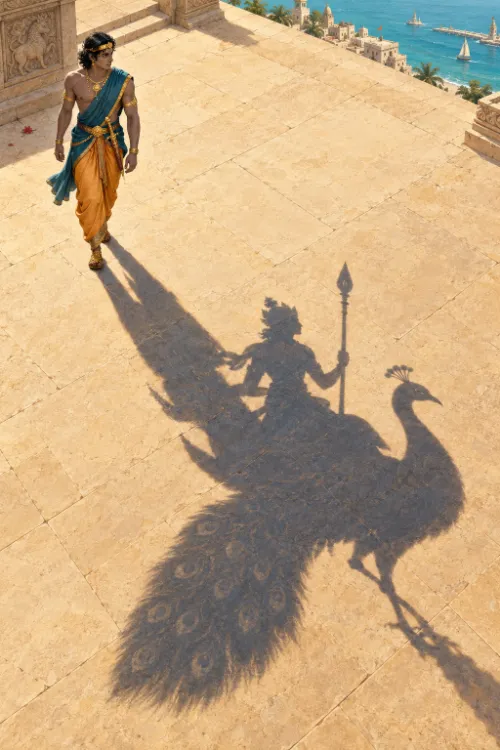
How Aṁśa-Participation Explains Sāmba, Pradyumna and Uddhava
At first glance, Śrīmad-Bhāgavatam 3.1.30 seems to make a straightforward statement: Sāmba, the son of Kṛṣṇa and Jāmbavatī, had previously been Kārttikeya, the son of Śiva and Pārvatī.
But the passage becomes much more interesting once the Sanskrit, the surrounding verses, and the Gauḍīya commentarial tradition are brought together. The text is not simply describing an ordinary case of reincarnation.
Rather, it opens a window into a much larger theological principle: when Bhagavān descends, He does not descend alone. His expansions, associates, energies, and even celestial personalities descend or participate with Him through their portions.
Sāmba is one example. Pradyumna is another. Uddhava is another. And even the apparently unrelated sentence in Prabhupāda’s purport about Kṛṣṇa appearing to Devakī and Vasudeva “in His capacity of Nārāyaṇa” belongs to the same theological logic.
The Original Verse
कच्चिद्धरेः सौम्य सुतः सदृक्ष
आस्तेऽग्रणी रथिनां साधु साम्बः ।
असूत यं जाम्बवती व्रताढ्या
देवं गुहं योऽम्बिकया धृतोऽग्रे ॥
kaccid dhareḥ saumya sutaḥ sadṛkṣa
āste ’graṇī rathināṁ sādhu sāmbaḥ
asūta yaṁ jāmbavatī vratāḍhyā
devaṁ guhaṁ yo ’mbikayā dhṛto ’gre
“O gentle one, is Sāmba well—the son of Hari, resembling Him, foremost among chariot-warriors? Jāmbavatī, rich in sacred vows, bore him, the god Guha, who previously had been borne by Ambikā.”
Śrīmad-Bhāgavatam 3.1.30
Prabhupāda renders the theological sense more explicitly:
“O gentle one, does Sāmba fare well? He exactly resembles the son of the Personality of Godhead. In a previous birth he was born as Kārttikeya in the womb of the wife of Lord Śiva, and now he has been born in the womb of Jāmbavatī, the most enriched wife of Kṛṣṇa.”
The key identification is not supplied merely by a later commentator. It is already in the Sanskrit: devaṁ guham “the god Guha.” Guha is one of the ancient names of Skanda or Kārttikeya, the martial son of Śiva.
And the verse adds: yo ’mbikayā dhṛto ’gre “who previously was borne by Ambikā.” Ambikā here is Pārvatī, the consort of Śiva. So the Bhāgavata itself unmistakably connects: Sāmba → Guha → Kārttikeya → Ambikā.
Sāmba Was Not an Ordinary Son
The verse describes Sāmba with three striking expressions.
दुर्योधनसुतां राजन्
लक्ष्मणां समितिंजयः ।
स्वयंवरस्थामहरत्
साम्बो जाम्बवतीसुतः ॥
duryodhana-sutāṁ rājan
lakṣmaṇāṁ samitiṁ-jayaḥ
svayaṁvara-sthām aharat
sāmbo jāmbavatī-sutaḥ
“O King, Sāmba, the son of Jāmbavatī and victorious in battle, carried away Duryodhana’s daughter Lakṣmaṇā from her svayaṁvara.”
Śrīmad-Bhāgavatam 10.68.1
The expression: samitiṁ-jayaḥ means roughly: “victorious in battle.” Thus the Bhāgavata consistently remembers Sāmba as a warrior. That is particularly suggestive because Kārttikeya is himself the archetypal divine warrior—the commander of the celestial armies.
The text does not explicitly say that Sāmba’s military prowess derives from Kārttikeya, so that connection should not be overstated. But the correspondence is unmistakable.
Who Is Kārttikeya?
Kārttikeya is known throughout Sanskrit literature under several names: Skanda, Kumāra, Guha, Ṣaṇmukha, Subrahmaṇya. He is the son of Śiva and Pārvatī and is especially associated with: martial power, command, youthful heroism, divine warfare, and the defeat of demonic forces.
Thus when Bhāgavatam 3.1.30 calls Sāmba: devaṁ guham it is making an exceptionally strong identification. But this creates an immediate problem. Was the cosmic deity Kārttikeya literally gone from his own celestial function because he had reincarnated as Sāmba?
The Gauḍīya commentators answer: not in that simplistic sense.
Why “Reincarnation” Is Too Crude
The English expression “in a previous birth he was Kārttikeya” naturally sounds like ordinary transmigration: Kārttikeya dies → receives another body → becomes Sāmba. But Purāṇic theology allows more complex relationships.
The traditional vocabulary includes: aṁśa — portion, partial manifestation aṁśī — the fuller source possessing the aṁśa āveśa — entrance or empowerment avatāra — descent kalā — partial manifestation or functional portion vilāsa — personal expansion manifesting another form or mood.
A celestial personality can therefore participate in an earthly divine līlā through an aṁśa without exhausting his entire identity in that manifestation. This is how Gauḍīya commentators explain Sāmba.
Kārttikeya does not need to cease existing elsewhere. Rather: Kārttikeya’s aṁśa participates in Sāmba’s manifested identity.
Jīva Gosvāmī Gives the Key
Jīva Gosvāmī’s explanation is concise but extremely important. He treats the Sāmba–Kārttikeya relationship as analogous to the relationship between: Pradyumna and Kāmadeva.
In other words:
Sāmba is called Kārttikeya in the same way that Pradyumna is called Kāmadeva.
That sends us directly to another question Vidura had asked only two verses earlier.
Pradyumna and Kāmadeva: The Parallel Case
कच्चिद्वरूथाधिपतिर्यदूनां
प्रद्युम्न आस्ते सुखमङ्ग वीरः ।
यं रुक्मिणी भगवतोऽभिलेभे
आराध्य विप्रान् स्मरमादिसर्गे ॥
kaccid varūthādhipatir yadūnāṁ
pradyumna āste sukham aṅga vīraḥ
yaṁ rukmiṇī bhagavato ’bhilebhe
ārādhya viprān smaram ādi-sarge
“O dear one, is the heroic Pradyumna, commander among the Yadus, well—the son whom Rukmiṇī obtained from Bhagavān, who had been Smara, Kāmadeva, in the beginning?”
Śrīmad-Bhāgavatam 3.1.28
So within the same sequence Vidura asks about: Pradyumna → Kāmadeva and then: Sāmba → Kārttikeya. That is clearly deliberate.
The Tenth Canto Explains the Pradyumna Case
कामस्तु वासुदेवांशो
दग्धः प्राग् रुद्रमन्युना ।
देहोपपत्तये भूयस्
तमेव प्रत्यपद्यत ॥
kāmas tu vāsudevāṁśo
dagdhaḥ prāg rudra-manyunā
dehopapattaye bhūyas
tam eva pratyapadyata
“Kāma, who is an aṁśa of Vāsudeva and who had previously been burned by the anger of Rudra, again took shelter of Him in order to obtain embodiment.”
Śrīmad-Bhāgavatam 10.55.1
The crucial expression is: vāsudevāṁśaḥ “an aṁśa of Vāsudeva.” Thus Kāmadeva’s relationship to Pradyumna is already far more complicated than ordinary reincarnation. In Gauḍīya theology, the divine Pradyumna exists as an eternal expansion within the Lord’s own spiritual hierarchy, while the celestial Kāmadeva participates in the earthly manifestation associated with Him.
The same explanatory model is then used for Sāmba.
Viśvanātha Cakravartī Makes the Principle Explicit
Viśvanātha Cakravartī Ṭhākura explains that these identities occur through aṁśa participation. Thus:
- Kāmadeva enters Pradyumna
- Kārttikeya enters Sāmba
- a Vasu enters Uddhava.
This prevents a major theological misunderstanding. The statement: “Sāmba is Kārttikeya” does not necessarily mean: “Sāmba’s entire identity is nothing but a reborn demigod.”
Rather, the earthly personality can carry multiple layers of identity simultaneously.
Uddhava Is the Third Example
Prabhupāda’s purport continues the pattern by mentioning Uddhava. When Kṛṣṇa appeared, various celestial beings accompanied His līlā. Among the examples given are:
- Kāmadeva → Pradyumna
- Kārttikeya → Sāmba
- one of the Vasus → Uddhava.
This should immediately alert us that the purport is teaching a general principle rather than merely supplying biographies of three individuals. The principle is:
When Bhagavān descends, personalities from higher cosmic realms can also participate in the earthly līlā through their portions.
The Tenth Canto explicitly says so.
Brahmā Commands the Devas to Descend Through Their Portions
Before Kṛṣṇa’s birth, the burdened Earth appeals for divine intervention. Brahmā communicates the Lord’s instruction to the devas.
पुरैव पुंसावधृतो धराज्वरो
भवद्भिरंशैर्यदुषूपजन्यताम् ।
स यावदुर्व्या भरमीश्वरेश्वरः
स्वकालशक्त्या क्षपयंश्चरेद् भुवि ॥
puraiva puṁsāvadhṛto dharā-jvaro
bhavadbhir aṁśair yaduṣūpajanyatām
sa yāvad urvyā bharam īśvareśvaraḥ
sva-kāla-śaktyā kṣapayaṁś cared bhuvi
“The distress of the Earth has already been understood by the Supreme Lord. Therefore, while the Lord of all lords moves upon the Earth and diminishes its burden through His own power of time, you should take birth among the Yadus through your portions.”
Śrīmad-Bhāgavatam 10.1.22
The decisive phrase is: bhavadbhir aṁśaiḥ “through your portions.” That gives an explicit Bhāgavata basis for the commentarial explanation. The devas need not abandon their entire cosmic identities.
Their aṁśas descend.
Kṛṣṇa’s Descent Is the Descent of an Entire Divine World
This radically changes how Kṛṣṇa’s avatāra should be imagined. It is not merely: one supernatural person suddenly appears among ordinary humanity. Rather, the līlā arrives as a vast coordinated manifestation involving: Kṛṣṇa Himself, His expansions, His energies, His eternal associates, celestial participants, family members, servants, warriors, queens, friends, and even the divine paraphernalia surrounding Him.
The visible earthly līlā is therefore the manifestation of an entire spiritual and cosmic network. Sāmba belongs to that network.
Jāmbavatī Is Called Vratāḍhyā
The Bhāgavata uses a particularly interesting adjective for Sāmba’s mother: jāmbavatī vratāḍhyā vrata — sacred vow, religious observance, austerity āḍhya — rich, abundant, endowed.
Thus: vratāḍhyā “rich in vows,” “greatly endowed with sacred observances.” Why mention this specifically in connection with Sāmba? The Mahābhārata preserves a fascinating tradition about Jāmbavatī’s desire for a son.
After seeing Rukmiṇī’s extraordinary sons, she asks Kṛṣṇa to grant her a similarly powerful child.
प्रद्युम्नचारुदेष्णादीन्
रुक्मिण्या वीक्ष्य पुत्रकान् ।
पुत्रार्थिनी मामुपेत्य
वाक्यमाह युधिष्ठिर ॥
pradyumna-cārudeṣṇādīn
rukmiṇyā vīkṣya putrakān
putrārthinī mām upetya
vākyam āha yudhiṣṭhira
“O Yudhiṣṭhira, after seeing Rukmiṇī’s sons such as Pradyumna and Cārudeṣṇa, Jāmbavatī approached Me desiring a son.”
Mahābhārata, Anuśāsana-parvan
Then Jāmbavatī makes her request.
शूरं बलवतां श्रेष्ठं
कान्तरूपमकल्मषम् ।
आत्मतुल्यं मम सुतं
प्रयच्छाच्युत मा चिरम् ॥
śūraṁ balavatāṁ śreṣṭhaṁ
kānta-rūpam akalmaṣam
ātma-tulyaṁ mama sutaṁ
prayacchācyuta mā ciram
“O Acyuta, please grant me without delay a heroic son, foremost among the strong, beautiful, faultless, and comparable to Yourself.”
Mahābhārata, Anuśāsana-parvan
The phrase: ātma-tulyam “like Yourself” beautifully parallels the Bhāgavata’s: sadṛkṣaḥ “resembling Him.”
Sāmba’s Birth Is Also Connected With Śiva
The Mahābhārata narrative goes even further. Kṛṣṇa undertakes extraordinary austerities and worship connected with Śiva in response to Jāmbavatī’s desire for such a son. Eventually Umā announces:
दत्तो भगवता पुत्रः
साम्बो नाम तवानघ ।
मत्तोऽप्यष्टौ वरानिष्टान्
गृहाण त्वं ददामि ते ॥
datto bhagavatā putraḥ
sāmbo nāma tavānagha
matto ’py aṣṭau varān iṣṭān
gṛhāṇa tvaṁ dadāmi te
“O sinless one, the Lord has granted you a son named Sāmba. Accept from me also eight desired boons.”
Mahābhārata, Anuśāsana-parvan
The exact numbering of this passage differs among editions of the Mahābhārata, but the narrative itself is important. It creates a striking independent connection: Jāmbavatī desires a powerful son → Kṛṣṇa’s austerities are connected with Śiva → Umā announces Sāmba’s birth → the Bhāgavata later identifies Sāmba as Guha/Kārttikeya.
That convergence is difficult to miss.
A Coherent Portrait of Sāmba Emerges
Put the traditions together. Jāmbavatī asks for: śūram — a heroic son balavatāṁ śreṣṭham — foremost among the strong ātma-tulyam — like Kṛṣṇa Himself. The Bhāgavata describes him as: sadṛkṣaḥ — resembling Kṛṣṇa agraṇī rathinām — foremost among chariot-warriors and later: samitiṁ-jayaḥ — victorious in battle.
Then it identifies him with: Guha/Kārttikeya the divine warrior son of Śiva. These are not isolated details. Together they create a remarkably coherent portrait.
What About Śiva Himself?
Because Kārttikeya is Śiva’s son, Prabhupāda’s purport naturally touches upon Śiva-tattva. Gauḍīya theology places Śiva in a special ontological category. He is not treated as an ordinary conditioned jīva.
Yet neither is he simply identical in every respect with the Viṣṇu-tattva manifestations. The classic analogy comes from the Brahma-saṁhitā.
क्षीरं यथा दधि विकारविशेषयोगात्
सञ्जायते न हि ततः पृथगस्ति हेतोः ।
यः शम्भुतामपि तथा समुपैति कार्याद्
गोविन्दमादिपुरुषं तमहं भजामि ॥
kṣīraṁ yathā dadhi vikāra-viśeṣa-yogāt
sañjāyate na hi tataḥ pṛthag asti hetoḥ
yaḥ śambhutām api tathā samupaiti kāryād
govindam ādi-puruṣaṁ tam ahaṁ bhajāmi
“I worship Govinda, the original Person, who assumes the state of Śambhu for a particular function, just as milk becomes yogurt through a particular transformation, although yogurt is not independent of its cause, milk.”
Brahma-saṁhitā 5.45
The analogy is carefully chosen. Yogurt comes from milk. It is not independent of milk. But yogurt cannot simply be treated as milk in every respect. Likewise, Śambhu is profoundly related to Govinda while possessing a distinct theological function.
The Strange Nārāyaṇa Statement in the Purport
Prabhupāda then says something that may initially appear unrelated to Sāmba:
When Kṛṣṇa appeared as Vāsudeva before Devakī and Vasudeva, He appeared in His capacity of Nārāyaṇa.
Why introduce Nārāyaṇa while discussing Kārttikeya? Because the same theological principle is being illustrated. A divine manifestation can contain or be accompanied by another divine manifestation.
To understand this properly, however, we need to distinguish two almost identical Sanskrit names.
Vasudeva and Vāsudeva Are Not the Same Word
This distinction is important.
Thus when a commentary speaks about “Vāsudeva,” one must determine from context whether it means simply Kṛṣṇa, son of Vasudeva, or a specific majestic expansion associated with the catur-vyūha and Nārāyaṇa theology.
Kṛṣṇa First Appears Before Devakī in a Four-Armed Form
When Kṛṣṇa manifests in the prison of Kaṁsa, He does not initially appear merely as an ordinary human infant.
तमद्भुतं बालकमम्बुजेक्षणं
चतुर्भुजं शङ्खगदाद्युदायुधम् ।
श्रीवत्सलक्ष्मं गलशोभिकौस्तुभं
पीताम्बरं सान्द्रपयोदसौभगम् ॥
tam adbhutaṁ bālakam ambujekṣaṇaṁ
catur-bhujaṁ śaṅkha-gadādy-udāyudham
śrīvatsa-lakṣmaṁ gala-śobhi-kaustubhaṁ
pītāmbaraṁ sāndra-payoda-saubhagam
“Vasudeva saw that wonderful child, lotus-eyed and four-armed, holding the conch, club and other divine weapons, marked with Śrīvatsa, adorned with the Kaustubha jewel upon His neck, dressed in yellow garments, and beautiful like a dense rain cloud.”
Śrīmad-Bhāgavatam 10.3.9
This is clearly a majestic Viṣṇu-Nārāyaṇa manifestation. He has: four arms, divine weapons, Śrīvatsa, Kaustubha, yellow garments. Devakī and Vasudeva immediately recognize that this is no ordinary infant.
Then the Majestic Form Is Concealed
After speaking with His parents, Bhagavān hides this explicit manifestation of divinity.
इत्युक्त्वासीद्धरिस्तूष्णीं
भगवानात्ममायया ।
पित्रोः सम्पश्यतोः सद्यो
बभूव प्राकृतः शिशुः ॥
ity uktvāsīd dharis tūṣṇīṁ
bhagavān ātma-māyayā
pitroḥ sampaśyatoḥ sadyo
babhūva prākṛtaḥ śiśuḥ
“Having spoken thus, Bhagavān Hari became silent and, through His own internal potency, immediately appeared before His parents like an ordinary human infant.”
Śrīmad-Bhāgavatam 10.3.46
The word prākṛtaḥ here does not mean that Kṛṣṇa suddenly acquired an ordinary material body. The sense is that He appeared like an ordinary child. Thus the birth narrative itself contains two modes of manifestation: majestic four-armed revelation → humanlike infant Kṛṣṇa.
This is an important background to Prabhupāda’s phrase “in His capacity of Nārāyaṇa.”
Does This Mean Nārāyaṇa Is the Source of Kṛṣṇa?
No. This is where the Gauḍīya conclusion must be stated carefully. If Prabhupāda’s sentence were isolated from the wider tradition, someone might mistakenly conclude: Nārāyaṇa is original and Kṛṣṇa is merely His subordinate incarnation.
But Caitanya-caritāmṛta explicitly teaches the opposite hierarchy in Gauḍīya siddhānta.
সেই তিনের অংশী পরব্যোম-নারায়ণ ।
তেঁহ তোমার বিলাস, তুমি মূল-নারায়ণ ॥
sei tinera aṁśī paravyoma-nārāyaṇa
teṅha tomāra vilāsa, tumi mūla-nārāyaṇa
“The Nārāyaṇa of the spiritual sky is the source of the three puruṣa manifestations. Yet He is Your vilāsa expansion; You are the original Nārāyaṇa.”
Caitanya-caritāmṛta, Ādi 2.57
The decisive expressions are: teṅha tomāra vilāsa “He is Your vilāsa expansion.” and: tumi mūla-nārāyaṇa “You are the original Nārāyaṇa.” Thus Gauḍīya theology does not place the original Kṛṣṇa beneath Vaikuṇṭha Nārāyaṇa.
Rather: Kṛṣṇa is svayaṁ Bhagavān and: Nārāyaṇa is His majestic expansion.
Then What Does “Kṛṣṇa Appeared in His Capacity as Nārāyaṇa” Mean?
It means that the Nārāyaṇa/Vāsudeva aspect was manifest within Kṛṣṇa’s appearance before Devakī and Vasudeva. This is entirely compatible with Kṛṣṇa being the original source.
The original can contain its own expansions. The presence of Nārāyaṇa within Kṛṣṇa does not make Kṛṣṇa subordinate to Nārāyaṇa. On the contrary, the ability to manifest and contain such divine expansions belongs to Kṛṣṇa’s fullness.
This becomes especially clear from another Third Canto verse.
Kṛṣṇa Appears Accompanied by His Great Expansions
स्वशान्तरूपेष्वितरैः स्वरूपैर्
अभ्यर्द्यमानेष्वनुकम्पितात्मा ।
परावरेशो महदंशयुक्तो
ह्यजोऽपि जातो भगवान् यथाग्निः ॥
sva-śānta-rūpeṣv itaraiḥ sva-rūpair
abhyardyamāneṣv anukampitātmā
parāvareśo mahad-aṁśa-yukto
hy ajo ’pi jāto bhagavān yathāgniḥ
“The unborn Bhagavān, Lord of both the higher and lower realms, appeared out of compassion, accompanied by His great portions, like fire becoming manifest.”
Śrīmad-Bhāgavatam 3.2.15
The crucial expression is: mahad-aṁśa-yuktaḥ “accompanied by,” “joined with,” “possessing His great aṁśas.” This is perhaps the most illuminating phrase for understanding the entire purport on Sāmba.
Kṛṣṇa descends with His great expansions present. Thus: Kṛṣṇa can manifest together with Nārāyaṇa. Sāmba can manifest together with Kārttikeya. Pradyumna can manifest together with Kāmadeva.
Uddhava can manifest together with a Vasu. The logic is parallel.
Vraja, Mathurā, and Dvārakā
This distinction also helps explain why Gauḍīya texts differentiate between Kṛṣṇa’s various līlā-settings.
Vraja
The dominant mood is: mādhurya sweetness, intimacy, humanlike closeness. Kṛṣṇa appears as: a cowherd boy, Yaśodā’s son, Nanda’s darling, the friend of the cowherd boys, the beloved of the gopīs.
His divinity is often almost hidden beneath intimacy.
Mathurā and Dvārakā
The mood increasingly includes: aiśvarya majesty, royal grandeur, explicit divine awareness. Here Kṛṣṇa appears as: a prince, a king, a warrior, the head of the Yādavas, surrounded by queens and palaces.
His majestic Vāsudeva-Nārāyaṇa aspect becomes more prominent. Sāmba belongs primarily to this Dvārakā family-līlā. Thus it makes theological sense that Prabhupāda discusses the expansion structure of Nārāyaṇa in the same purport.
One Person Can Carry More Than One Level of Identity
This is perhaps the most important conceptual lesson. Purāṇic and Gauḍīya theology does not always treat identity as a simple modern equation: Person A = only Person A. A līlā personality can simultaneously possess: an eternal spiritual identity, an earthly family identity, a cosmic function, and the participation of another celestial personality.
This gives us a layered structure.
Pradyumna
At one level: Kṛṣṇa and Rukmiṇī’s son. At another: a divine expansion connected with the catur-vyūha. Within the earthly līlā: Kāmadeva participates in his manifestation.
Sāmba
At one level: Kṛṣṇa and Jāmbavatī’s son. He resembles Kṛṣṇa and is an extraordinary warrior. Within the earthly līlā: Kārttikeya/Guha participates in his manifestation.
Uddhava
At one level: Kṛṣṇa’s extraordinarily intimate devotee and counselor. Within the manifested līlā: a Vasu participates in his earthly appearance. The celestial identity therefore need not exhaust the deeper identity of the devotee.
This Prevents a Common Mistake
It would therefore be misleading to construct the following equations:
- Pradyumna = merely Cupid
- Sāmba = merely Kārttikeya
- Uddhava = merely a Vasu.
The commentarial tradition points toward something subtler.
Celestial personalities can enter into or participate within personalities of Kṛṣṇa-līlā. Thus the correct theological picture is closer to: eternal līlā-personality + participating celestial aṁśa rather than: ordinary reincarnated demigod.
Why Would the Devas Participate at All?
Because Kṛṣṇa’s earthly līlā requires an enormous supporting world. It contains: dynasties, armies, marriages, political struggles, warfare, pilgrimages, friendships, family relationships, rivalries, devotees, opponents.
Celestial personalities therefore appear in appropriate roles. Their existing cosmic characteristics often correspond strikingly with their earthly participation. Thus: the martial Kārttikeya participates in the warrior Sāmba; Kāmadeva participates in the beautiful and powerful Pradyumna; a Vasu participates in the wise and exalted Uddhava.
Kṛṣṇa’s līlā becomes a vast coordinated descent.
Sāmba’s Later Role Is Also Remarkable
Sāmba later occupies a famous and controversial place near the end of the Yadu dynasty’s earthly manifestation. Young Yādavas disguise Sāmba as a pregnant woman and jokingly ask sages what child “she” will bear.
The sages pronounce that Sāmba will give birth to an iron club. That club eventually becomes an instrument in the destruction of the Yadu dynasty’s manifest earthly līlā.
It may be tempting to say: “Kārttikeya is associated with destruction, therefore Sāmba caused the destruction of the Yadus.” That would go too far. The Bhāgavata ultimately places the disappearance of the Yadu dynasty within Kṛṣṇa’s own providential arrangement.
Sāmba is an instrument within that unfolding, not an independent cosmic saboteur. Still, the fact that the personality associated with the divine warrior Skanda becomes involved at such a decisive moment is an intriguing thematic resonance.
It should be recognized as an observation—not elevated into an explicit śāstric doctrine.
The Larger Theology of Avatāra
The Sāmba verse therefore teaches something much larger than the biography of one prince. It reveals how the Purāṇic world understands divine descent. An avatāra is not merely:
God putting on a human body.
It is the manifestation of a whole divine arrangement. Bhagavān descends. His expansions descend. His energies descend. His associates descend. Celestial personalities participate.
The environment appropriate for the līlā manifests. Thus Kṛṣṇa’s earthly presence is simultaneously: historical within the narrative, cosmic, theological, and transcendental.
The Apparently Small Purport Is Actually Explaining a General Law
Now Prabhupāda’s seemingly disconnected statements fit together. He mentions:
- Kāmadeva as Pradyumna
- Kārttikeya as Sāmba
- a Vasu as Uddhava
and then: Nārāyaṇa appearing within Kṛṣṇa’s manifestation as Vāsudeva.
Why? Because all four examples illustrate the same principle:
A greater līlā manifestation can include other divine or celestial personalities within it without those personalities exhausting the identity of the principal manifestation.
Thus: Kārttikeya can be present in Sāmba without Sāmba being reducible to Kārttikeya. Kāmadeva can be present in Pradyumna without Pradyumna being reducible to Kāmadeva. Nārāyaṇa can be present in Kṛṣṇa’s majestic Mathurā manifestation without the original Kṛṣṇa being reducible to an incarnation of Nārāyaṇa.
This is the hidden logic of the purport.
The Most Precise Way to Understand Sāmba
Instead of saying simply:
“Kārttikeya reincarnated as Sāmba,”
a more careful formulation would be:
Sāmba is Kṛṣṇa and Jāmbavatī’s extraordinary son, a foremost Yadu warrior who resembles Kṛṣṇa. The Bhāgavata identifies him with Guha, Kārttikeya, previously borne by Ambikā. Gauḍīya commentators explain this identification through aṁśa-participation: Kārttikeya participates within Sāmba’s manifest earthly identity, just as Kāmadeva participates in Pradyumna and a Vasu participates in Uddhava.
That preserves both the Sanskrit text and the theological sophistication of the commentaries.
The Most Precise Way to Understand the Nārāyaṇa Statement
Likewise, instead of reading:
“Vāsudeva is an expansion of Nārāyaṇa”
as though Gauḍīya theology were saying:
“Nārāyaṇa is ultimately higher than Kṛṣṇa,”
the more accurate interpretation is:
When Kṛṣṇa appeared before Devakī and Vasudeva, He manifested the majestic four-armed Nārāyaṇa/Vāsudeva aspect accompanying His descent. This does not overturn the Gauḍīya doctrine that Kṛṣṇa is svayaṁ Bhagavān and that Vaikuṇṭha Nārāyaṇa is His vilāsa expansion.
The original can manifest its own expansions without ceasing to be their source.
The verse therefore invites us to think differently about identity in divine līlā. Sāmba is not merely: a prince, a warrior, or “Kārttikeya reincarnated.” He is part of the extraordinarily layered architecture surrounding Kṛṣṇa’s descent.
Behind the visible Yadu prince stands: the son of Jāmbavatī, the resemblance to Kṛṣṇa, the heroic warrior, the connection with Śiva, the identity of Guha, the participating aṁśa of Kārttikeya, and the larger cosmic command that the devas should descend among the Yadus.
The same principle explains Pradyumna. It explains Uddhava. And, on a still higher level, it helps explain how Kṛṣṇa can manifest together with Nārāyaṇa and His other divine expansions while remaining the original source.
That is the real depth of the passage. The avatāra does not arrive alone. An entire divine world descends with Him. And Sāmba—Kṛṣṇa’s warrior son, carrying the participation of Guha—is one small but fascinating piece of that world.
Primary Texts Discussed
- Śrīmad-Bhāgavatam
3.1.28
3.1.30
3.2.15
10.1.22
10.3.9
10.3.46
10.55.1
10.68.1 - Brahma-saṁhitā
5.45 - Caitanya-caritāmṛta, Ādi-līlā
2.57 - Mahābhārata, Anuśāsana-parvan
The Jāmbavatī–Sāmba narrative associated with Kṛṣṇa’s worship of Śiva. Verse numbering varies somewhat between editions.
Source Sites
- Bhaktivedanta VedaBase — vedabase.io
For the Sanskrit, transliteration, translations, and Gauḍīya Vaiṣṇava purports to the Śrīmad-Bhāgavatam, Brahma-saṁhitā, and Caitanya-caritāmṛta. - Bhāgavatam Commentaries / Ṭīkā collections — bhagavatam-tikas.blogspot.com
For English presentations of traditional commentaries, especially Jīva Gosvāmī and Viśvanātha Cakravartī Ṭhākura on Śrīmad-Bhāgavatam 3.1.30. - GRETIL / Sanskrit text repositories
For comparison with Sanskrit editions of the Mahābhārata. - Wisdomlib — wisdomlib.org
For searchable Sanskrit editions and cross-checking passages from the Mahābhārata and Purāṇic literature.